

A vendor’s security certificate is only the beginning. The best IT asset disposition RFP questions for enterprise security teams require clear answers on how data is protected, sanitized or destroyed, who can access equipment, and what evidence supports each assurance. Ask for documented procedures, relevant certifications, incident and exception handling, secure transport and custody, contractual responsibilities, and item-level completion reports. A security questionnaire typically contains 50-400 questions, so prioritize requirements that reflect your assets, data classifications, and risk.
Security teams know that confident assurances are no substitute for evidence. A well-structured RFP makes vendor responses easier to assess by requesting specific documentation and clear commitments, while giving procurement and operations teams a shared basis for decisions. This guide sets out practical questions on security and compliance, data privacy, vendor assurance, contracts, delivery, and reporting. Use them to build a focused questionnaire that protects sensitive information and supports responsible end-of-life handling of your organization’s equipment.
Key Takeaways
- Use a consistent 1-5 scoring scale to compare vendor responses and document why each score was assigned.
- Match certification and experience questions to your organization’s requirements, then request supporting evidence for key claims.
- Set clear contract expectations for data access, incident handling, and post-termination data exports, including a defined timeframe.
- Specify the delivery milestones and closeout records your team needs to track equipment through disposition.
What security and compliance questions should the RFP ask?
Build a reusable template around your asset types, data classifications, and internal approval process. A focused questionnaire helps procurement evaluate evidence consistently while keeping security, environmental handling, and service delivery in view.
- Request the vendor’s disposition methodology, including sanitization, destruction, reuse, and exception handling. A documented sequence makes each outcome easier to assess.
- Ask for current certification details, scope, and supporting evidence, such as ISO/IEC 27001 documentation. Scope shows which operations the assurance covers.
- Request relevant team experience, staff training practices, and comparable project references. These details help assess whether the provider can manage your asset mix.
- Require itemized pricing requests, implementation steps, support responsibilities, and escalation routes. Clear terms help teams compare delivery as well as cost.
For data sanitization, ask which methods apply to each media type, how completion is verified, and what happens if sanitization fails. Require a destruction record or verification evidence linked to the asset identifier so your team can reconcile the results.
For Canadian environmental and e-waste compliance, ask how the vendor identifies downstream destinations, manages reuse and recycling, and documents final outcomes. Request records showing how each asset’s disposition is classified and how exceptions are handled.
For chain of custody, require an asset-level record covering the process from collection through final disposition. It should capture identifiers, custody transfers, dates, locations, and status changes to provide a traceable history.
Include questions about governance and support: who leads implementation, how staff receive process guidance, and how service issues are escalated. Ask vendors to describe their methodology and provide a relevant reference for your organization’s equipment and operating environment.
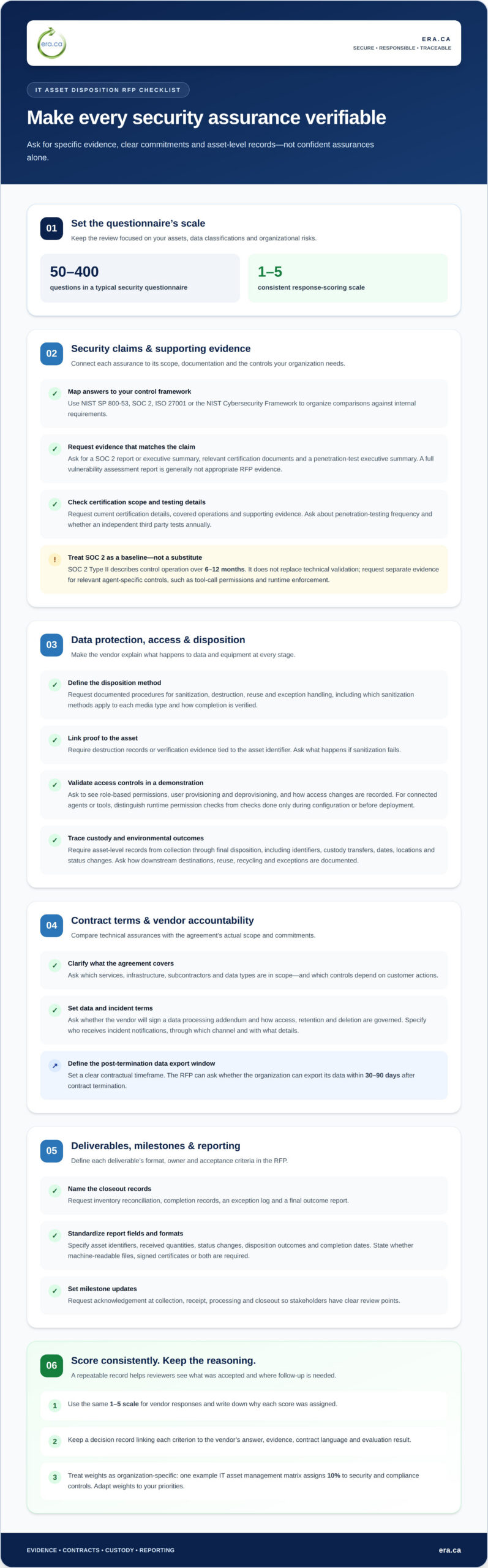
Score responses on a consistent 1-5 scale, with written reasons for each rating. One example IT asset management matrix assigns 10% to security and compliance controls; adapt weights to your priorities rather than treating a typical template as universal.
Vendor questions about security assurances and contractual terms
Ask vendors to map security answers to your control framework, then provide evidence for each claim. NIST SP 800-53, SOC 2, ISO 27001, and the NIST Cybersecurity Framework can help organize comparisons against internal requirements. Request a SOC 2 report or executive summary, relevant certification documents, and a penetration-test executive summary. A full vulnerability assessment report is generally not appropriate RFP evidence.
- Contract scope: Which services, infrastructure, subcontractors, and data types does the agreement cover?
- Data terms: Will the vendor sign a data processing addendum, and how are access, retention, and deletion governed?
- Incident handling: Who receives incident notifications, through which channel, and what details are provided?
- Exit terms: Can the organization export its data within 30 to 90 days after contract termination?
Compare technical assurances with the contract’s actual commitments. Ask vendors to identify exceptions, responsibility boundaries, and controls that depend on customer actions. For penetration testing, request the executive summary and testing frequency. You can also ask whether an independent third party conducts testing annually.
Validate access control in demonstrations, not just written responses. Ask the vendor to show role-based permissions, user provisioning and deprovisioning, and how access changes are recorded. For connected agents or tools, distinguish runtime permission checks from checks performed only during configuration or before deployment. Ask how permission changes are reviewed and approved.
SOC 2 Trust Services Criteria provide a general security baseline, but they don’t assess agent-specific behaviours such as tool-call permissions or runtime enforcement. If those functions apply, request separate evidence of the relevant controls. SOC 2 Type II describes control operation over 6-12 months; it should support, not replace, technical validation.
Keep a decision record for each criterion, linking the vendor’s answer, evidence, contract language, and evaluation result. This helps reviewers see why controls are acceptable and where follow-up contract terms may be needed.
Deliverables, timelines, and reporting expectations
Define each deliverable, its format, owner, and acceptance criteria in the RFP. For asset disposition, request an inventory reconciliation, completion records, an exception log, and a final outcome report. These records help security, finance, and sustainability teams assess whether milestones were met and asset-level records remain complete.
- Set reporting fields. Require asset identifiers, received quantities, status changes, disposition outcomes, and completion dates; consistent fields make internal reconciliation more reliable.
- Specify report formats. State whether the vendor must provide machine-readable files, signed certificates, or both; a sample custom report can reveal gaps before implementation.
- Define milestone updates. Ask for acknowledgement at collection, receipt, processing, and closeout; each update gives stakeholders a clear point to review progress.
- Describe exception handling. Require prompt notice of missing, damaged, or unprocessable assets, plus the actions taken and final resolution.
Plan the RFP calendar by stage. Internal research typically takes 1 to 3 weeks; drafting the RFP and defining its evaluation model takes 1 to 2 weeks. Vendor response cycles often span 2 to 4 weeks, while proposal evaluation and a final decision take 2 to 6 weeks. Build review time into the schedule so security, procurement, and operations can assess responses together.
Set a contractual breach-notification process with a defined timeframe, notification channel, escalation contact, and required incident details. Ask vendors how they handle suspected and confirmed incidents, as well as subsequent updates. Canadian organizations should align the contract process with applicable privacy obligations. Notification rules depend on the circumstances and governing requirements.
Close with scoring instructions. Apply the same criteria, weights, and evidence standards to every response, then record a reason for each score. Linking the proposal, supporting documents, reviewer assessment, and approval in a decision record makes the selection rationale easier to follow later.
Data security and privacy questions
Make data protection a structured part of procurement, not a broad assurance in a proposal. Ask how the vendor protects information during collection, transport, processing, and final disposition. Require details on encryption in transit and at rest, including who controls encryption keys and how access is restricted. This helps your organization assess exposure throughout the asset’s journey.
Use a checklist that follows data from device to outcome. Ask how the vendor identifies storage media, limits staff access, records handling actions, and manages exceptions such as unreadable drives. Request a sample asset-level record linking the device identifier to its final outcome. For retained records, ask what information they contain, who can access them, and how long they remain available.
How should enterprise ITAD RFPs address cross-border data transfers and subcontractors? Require vendors to identify where data is stored, accessed, or processed, and disclose subcontractors involved in each activity. Ask how contractual controls apply to those parties, how changes are communicated, and which safeguards apply across locations. This gives reviewers a clearer basis for assessing privacy and jurisdictional risks.
- Limit exposure: Ask whether personal or confidential information appears in reports, logs, or tracking records, and how sensitive fields are masked or access-restricted.
- Track exceptions: Require a documented escalation path for devices with unexpected data, failed processing, or missing identifiers.
- Protect evidence: Ask how records supporting disposition are secured, access-logged, and shared with authorized organizational contacts.
Keep the RFP specific to your data classifications and operating needs. A vendor’s written response should link each safeguard to a process, responsible role, or sample record. This makes privacy claims easier to assess alongside technical controls and contractual terms.
For organizations planning end-of-life handling for data-bearing equipment, explore secure data destruction as part of a privacy-conscious disposition process.
Electronic Recycling Association (ERA)
The Electronic Recycling Association (ERA) helps organizations move from RFP requirements to responsible handling of end-of-life equipment. Its services include secure data destruction, free electronics recycling, electronics pickup, and charitable computer donations. These options help teams connect data protection with reuse and recycling as equipment leaves service.
ERA states that it is certified to ISO/IEC 27001, ISO 9001, ISO 14001, and ISO 45001 standards. Include the assurance and supporting documentation relevant to your procurement requirements when assessing how a service fits your process.
For equipment that needs secure data handling alongside recycling or donation, contact the Electronic Recycling Association (ERA) to discuss your organization’s needs.
Put your requirements into practice
Use the IT asset disposition RFP questions for enterprise security teams as a working tool, not a document to file away after procurement. Before issuing your next request, bring security, privacy, procurement, and operations together to agree on the most important evidence, decision owners, and how to handle exceptions. That alignment turns written requirements into a consistent process from vendor selection through equipment closeout.
Preserve the reasoning behind each decision. A clear record of priorities helps teams apply consistent standards as asset volumes, internal controls, or service needs change. It also gives future reviewers a practical starting point, rather than forcing them to reconstruct why a control or contract term mattered.
When your organization is ready to plan responsible handling for retired equipment, contact Electronic Recycling Association (ERA). Thoughtful disposition can protect organizational information while supporting reuse and recycling where appropriate. Move forward with clear requirements and shared confidence.
Frequently Asked Questions
How should an enterprise compare qualified RFP responses?
Compare qualified proposals against the same scope, assumptions, and evidence standards, not headline claims. Separate mandatory pass-or-fail requirements from weighted preferences, then account for differences such as included handling steps, reporting formats, and exclusions. Have security, procurement, and operations review their respective areas before resolving gaps together. Keep clarification answers with each proposal so future reviewers can see which commitments informed the decision.
How should procurement use this template?
Use the template as a starting point, then tailor it to your organization’s asset types, data classifications, and approval process. Assign an owner to each requirement, such as security for data controls or operations for collection logistics. Add fields for the vendor’s response, supporting evidence, and any exceptions. Remove questions that do not apply, and circulate one controlled version so every vendor receives the same request.
What governance and access-control questions should the RFP ask?
Ask who approves vendor staff access, how permissions change when duties change, and how access is removed when work ends. Distinguish access for facility staff, administrators, and temporary personnel rather than treating all vendor accounts alike. Request a sample access-review record and the process for addressing an unapproved or dormant account. These questions show how governance works between formal reviews, not just during setup.
What security requirements should an enterprise include in an IT asset disposition RFP?
Set requirements by asset category and intended outcome, such as reuse, donation, recycling, or destruction. Practical IT asset disposition RFP questions for enterprise security teams should define what happens when a device cannot be processed as planned. Require a hold, escalation to an authorized contact, and documented approval before changing the disposition path. This makes exceptions visible and keeps handling aligned with organizational risk.
What ITAD certifications and audit reports should enterprise security teams require?
Request certifications relevant to the contracted work, including their scope and covered locations, rather than relying on a certificate name alone. For security assurance, ask whether a SOC 2 report or executive summary is available, alongside a penetration-test executive summary. Match evidence requests to the organization’s risk and information sensitivity. Review report dates, identified exceptions, and remediation status to understand what the documents actually demonstrate.
What questions should an ITAD RFP ask about facility, transport, and personnel security?
Ask how facility access is authorized and recorded, where equipment is held before processing, and how restricted areas are managed. For transport, request procedures for vehicle access, load protection, and custody transfers. For personnel, ask about role-based training, supervision, and access removal when assignments end. Include subcontractors in these questions so your organization can understand where responsibilities shift along the service route.