

The Moment Your Device Leaves Your Hands
You walk in, hand over an old laptop and a tangle of cables, and walk back out with your hands free. For most people that is the whole story. The device is gone, the clutter is cleared, and life moves on. What actually happens next is far more involved than a quick handoff at a counter.
The typical electronic waste drop off Ottawa residents complete takes only a couple of minutes, but it sets off a process that can stretch over days or even weeks. Behind the scenes, that laptop gets logged, its storage gets wiped or destroyed, its working parts get tested, and in many cases the whole machine gets a second life with someone who needs it. None of that is visible from the front desk.
This matters for two reasons. The first is your privacy. Old phones and computers hold tax records, saved passwords, photos, and work files, and you want to know that data does not survive the trip. The second is the environmental payoff, since a device that gets refurbished and reused keeps doing useful work instead of sitting in a landfill leaching lead and mercury into the soil.
ERA, a non-profit that has handled electronics in Canada since 2004, runs its Ottawa operation with both of those priorities in mind. Knowing the steps that follow your visit makes the choice to recycle responsibly feel a lot less like dropping something into a void. Here is what really happens to your gear once you let it go.
Intake and Sorting at the Depot
The back room of a recycling depot looks less like a junk pile and more like a receiving dock at a warehouse. Every item that comes through the door has to be accounted for before it can move to the next stage, and that accountability is the foundation everything else rests on.
When you drop something off at ERA’s Ottawa recycling depot on Sheffield Road, staff do not simply toss it onto a heap. They record what came in, give it a rough condition assessment, and route it toward the path that fits its state. A three-year-old business laptop and a cracked, water-damaged tablet follow very different journeys from this point forward, and sorting them correctly at the start saves a lot of wasted effort later.
How Devices Get Logged and Tracked
From the first electronic waste drop off Ottawa depots receive in the morning, every item gets a record before it goes anywhere. For a single donated phone that record might be brief. For a pallet of office computers it can be a detailed inventory with make, model, and serial numbers noted down one machine at a time.
This logging step is not bureaucratic busywork. It is what lets the people handling your equipment prove, later on, exactly what they did with it. If a company drops off forty hard drives and wants documentation that all forty were wiped or shredded, that paper trail starts at intake. Serial numbers recorded here can be matched against destruction records produced at the end.
The tracking also keeps reusable equipment from getting mixed up with material headed for teardown. A working monitor that gets accidentally routed to a shredder is a small environmental loss and a wasted resource. Careful intake records cut the odds of that kind of mistake. By the time your device moves out of receiving, the depot knows what it is, what condition it is in, and where it should go next.
Sorting Reusable Gear From Material Recycling
Not everything that arrives can be saved, and pretending otherwise would waste time and money. So the next decision is a practical one. Can this device realistically be refurbished and put back into service, or has it reached the end of its working life?
A laptop from five years ago with a healthy screen and a working keyboard is a strong candidate for reuse. A first-generation tablet with a swollen battery and a shattered display is not. Staff weigh repair cost against the value of the finished device, the same way any sensible person decides whether a car is worth fixing.
Items headed for reuse get set aside for testing and refurbishment. Items that cannot be saved get separated into material streams so their components can be recovered. Circuit boards, metals, plastics, and glass all have different recycling pathways, and keeping them sorted means more of each can actually be reclaimed rather than lost. ERA leans hard toward the reuse side of that line whenever it can, treating teardown as the last resort rather than the default.
Wiping Your Data Before Anything Else
Here is the part that worries most people, and rightly so. Before a device can be refurbished, sold for parts, or donated, anything personal stored on it has to be gone for good. A refurbished laptop that still holds the previous owner’s banking logins is a disaster waiting to happen, both for that owner and for the recycler’s reputation.
ERA treats data removal as a gate that every storage device has to pass through, not an optional add-on. The method depends on whether the drive can be safely cleared and reused or whether it needs to be physically destroyed. Both paths end in the same place, which is data that nobody can recover.
Software Erasure for Drives Headed Back Into Service
When a hard drive or solid-state drive is healthy enough to keep using, the goal is to erase it completely while leaving the hardware intact. Deleting files or even reformatting a drive the normal way does not cut it, because the underlying data often lingers and can be pulled back with freely available recovery tools.
Proper erasure overwrites every sector of the drive so the original contents cannot be reconstructed. ERA uses Blancco erasure software for this, a tool widely trusted in the industry precisely because it meets accepted standards for permanent data removal. Once a drive has been processed this way, it is genuinely blank, ready to host a fresh operating system for its next owner.
This approach is the backbone of ERA’s secure data destruction process, and it is why a wiped-and-reused drive carries no risk for the person who donated it. The original files are not hidden or locked away. They are overwritten and gone. Secure wiping of this kind is included at no charge as part of the recycling service, which matters because cost should never be the reason someone hands over a device with their data still on it.
Physical Shredding When a Drive Cannot Be Cleared
Some drives cannot be wiped. A hard drive that has failed mechanically will not respond to erasure software, and certain organizations have policies that require physical destruction whether or not a wipe is possible. For those cases, the answer is to destroy the drive outright.
ERA uses AmeriShred mobile hard drive shredders for this job. A shredder reduces a drive to fragments, turning the platters that once held your data into scrap metal. There is no recovering anything from a drive that has been through that process, which is exactly the point.
The mobile part is worth noting. For businesses with strict requirements, the shredding can happen on-site, so sensitive drives never leave the company’s premises intact. The owner can watch their drives get destroyed before the remains are taken away for material recycling, which closes the gap where a drive in transit is theoretically vulnerable. Destruction services like these may carry a small per-item fee depending on the equipment and certification needed, while standard software wiping stays free.
The Certificate That Proves It Was Done
For a home user, the satisfaction of knowing a drive was wiped is usually enough. For a business, knowing is not the same as being able to prove it. Auditors, regulators, and clients often want documentation, and that is where certificates of data destruction come in.
After ERA completes the wiping or shredding of a batch of drives, it can issue certification confirming the work was done. These certificates are typically available within about ten business days of the service, and serial numbers can be included on request so a company can match each destroyed drive against its own asset records.
This documentation closes the loop that started back at intake. The serial number logged when the equipment arrived shows up again on the destruction record, giving an unbroken account of what happened to each piece of hardware. For organizations bound by privacy legislation, that kind of evidence is often a legal requirement, and having it handled as part of the recycling service spares them from building a separate process of their own.
Chain of Custody for Sensitive Business Equipment
Individuals usually drop off one or two devices at a time. Businesses, government offices, and healthcare providers operate on a different scale, and the stakes are higher. A single electronic waste drop off Ottawa companies coordinate can involve dozens of machines, each one potentially holding confidential records, and that volume calls for a more rigorous approach to custody.
Chain of custody simply means an unbroken, documented account of who handled equipment and when, from the moment it leaves the client to the moment its data is destroyed. Every transfer point is a potential weak spot, so the goal is to leave no gaps where a device could go missing or be tampered with unnoticed.
This is where the intake logging, the secure transport, the wiping records, and the destruction certificates all connect into a single continuous record. A hospital retiring a batch of computers can follow each one through the process and receive proof at the end that its data obligations were met. ERA’s credibility here rests on more than promises, since the organization holds ISO/IEC 27001 certification for information security management, an internationally accepted standard that governs exactly this kind of controlled handling.
Refurbishing Working Devices for a Second Life
Once a device has been cleared of data, the focus shifts from protection to revival. A laptop that still has years of useful life left does no good sitting in storage, so the refurbishment stage is about getting it ready for a new home.
This is the part of the operation that sets a reuse-focused non-profit apart from a straightforward recycler. Plenty of operations are happy to shred everything and sell the raw materials. ERA would rather see a working computer back in service, and the refurbishment work exists to make that happen as efficiently as possible. The effort involved is more hands-on than most people expect.
Testing, Cleaning, and Reinstalling Software
A refurbished device has to actually work, and work reliably, or the whole effort is pointless. So each machine slated for reuse goes through functional testing. Technicians check that the screen displays properly, the keyboard and ports respond, the battery holds a charge, and the internal components run without errors.
Cleaning is part of it too. Years of dust get cleared out, sticky residue comes off the casing, and the device gets returned to something close to presentable condition. A donated computer that looks neglected is less likely to be appreciated by whoever receives it, so appearance counts for more than you might think.
With the data already wiped, technicians install a clean operating system so the machine boots up fresh, ready for a new user to set up as their own. You can see the full shape of how ERA reuses electronics laid out on its site, and the testing stage is what gives the organization confidence to put its name behind a refurbished device. The result is a computer that, while not brand new, is fully functional and genuinely useful. For a student, a newcomer to Canada, or a small charity running on a thin budget, a reliable refurbished laptop can be the difference between getting online and being left out.
What Happens to Parts That Cannot Be Saved
Not every device makes it to refurbishment, and not every part of a salvaged device is worth keeping. A laptop might have a perfect screen but a dead motherboard, or a desktop might be obsolete as a whole while its memory and drives are still useful. Nothing here gets wasted if it can be avoided.
Usable components get harvested and kept as spare parts, which then go toward repairing other machines. A working stick of RAM pulled from a dead computer might be exactly what brings another one back to life. This kind of parts recovery quietly stretches the worth of every donation further than a single device.
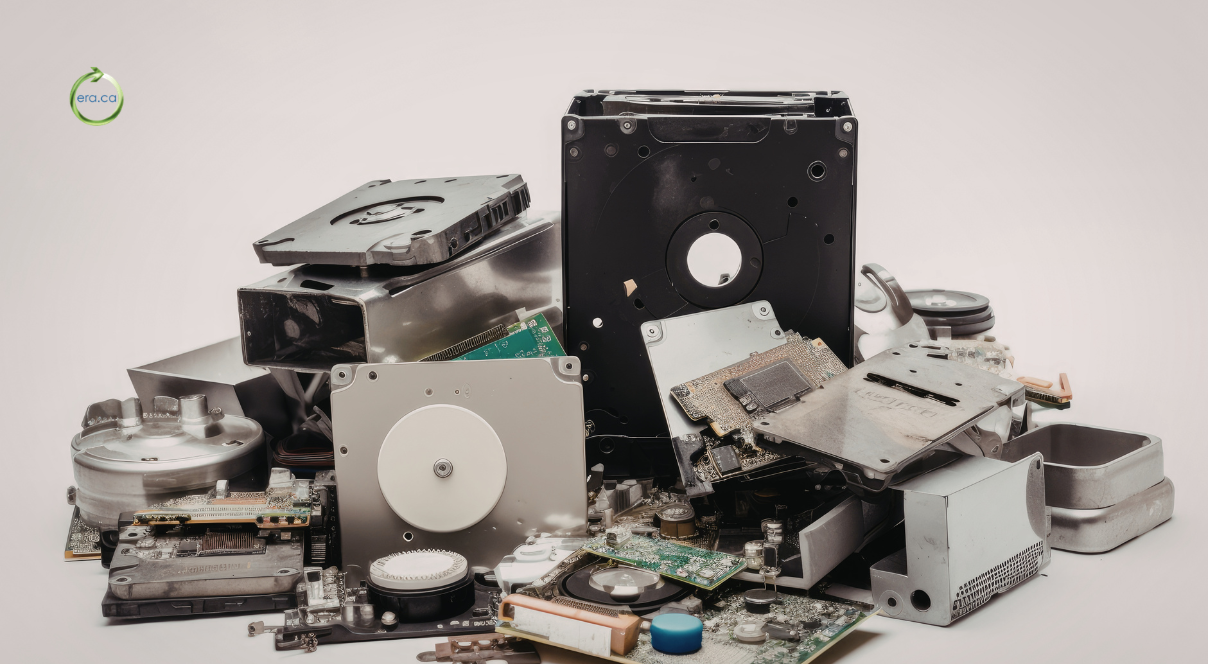
Whatever genuinely cannot be reused gets broken down into material streams for recycling. Metals are separated and sent for refining, circuit boards go to specialized processors that recover trace amounts of reclaimable materials, and plastics and glass follow their own routes. Handling these materials responsibly keeps toxic substances like lead and mercury out of landfills, where they would otherwise risk contaminating soil and groundwater. The principle running through all of it is simple. Reuse the whole device if you can, harvest the parts if you cannot, and recycle the raw materials only when there is nothing left to save.
Where Your Working Equipment Goes Next
A refurbished, fully tested computer with a clean operating system is ready to do good somewhere. For ERA, that somewhere is almost always a charity, a school, or a community organization rather than a resale shelf. The non-profit model shapes the destination as much as the process.
The devices people drop off become tools that help others, which is a far more satisfying ending than a slow decline in a junk drawer or a fast trip to the dump. This is the payoff that the wiping, testing, and refurbishment were all building toward, and it is where your old gear finally earns its second life.
Charities, Schools, and Community Groups
ERA donates refurbished equipment to organizations across the country, and the list of recipients is long and varied. Schools, community health centres, immigrant settlement services, youth programs, shelters, and First Nations organizations have all received devices through the program.
The need is real and constant. Regular access to a computer is no longer a luxury. Job applications, schoolwork, government services, and staying in touch with family all assume you have a device and a connection. A donated laptop can put those basics within reach for someone who could not otherwise afford them.
Some of the charities and community groups ERA supports request specific items they are short on, whether that is a batch of laptops for a classroom or a few tablets for a youth program. Matching donated equipment to those requests turns your old hardware into something genuinely targeted rather than a generic handout. There is also a modest low-cost option in some cases, where working devices are offered at a fraction of retail price to individuals who cannot manage a brand-new machine, and any funds raised that way go back into running the program.
Keeping Usable Devices Out of the Landfill
Electronic waste is one of the fastest-growing categories of garbage, and a lot of it does not need to be garbage at all. Every device that gets reused is one that does not have to be manufactured from scratch and one that does not end up buried in the ground.
The environmental math is straightforward. Building a new laptop consumes raw materials, energy, and water, and produces emissions along the way. Extending the life of an existing machine sidesteps all of that. Reuse is the most efficient form of recycling there is, because it skips the energy-intensive step of breaking a product down and rebuilding it.
Treating an electronic waste drop off Ottawa families and offices make as the start of reuse, rather than disposal, keeps working machines in service for years longer than they otherwise would be, and the diversion adds up quickly across thousands of donations. There is a community dimension to the landfill question as well. A device kept in use is a device helping a person, so the environmental benefit and the social benefit point in the same direction. Choosing reuse over the dump is one of the rare decisions where doing the responsible thing and doing the generous thing are the same choice.
Giving Your Old Electronics a Worthwhile Send-Off
The next time you clear out a drawer of forgotten gadgets, it helps to picture where they actually end up. With ERA, your devices get logged, wiped or shredded, tested, refurbished, and passed along to people across the Ottawa area who can put them to real use. It is a thorough process built on privacy and reuse in equal measure. Visit ERA’s Ottawa depot to give your old electronics a send-off that means something.