


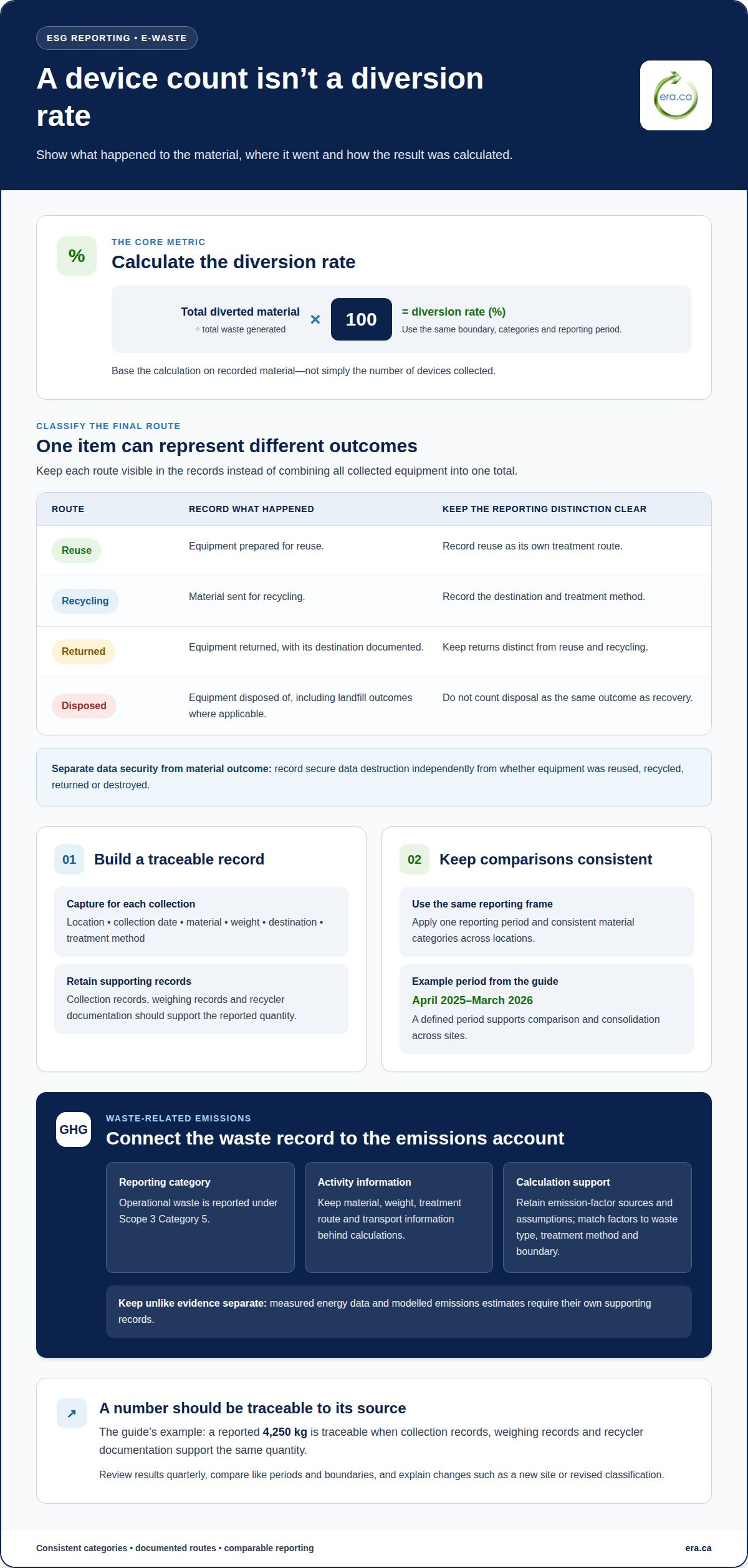
A device count alone can’t show whether your e-waste was diverted. For corporate ESG reporting for e-waste diversion metrics, calculate the diversion rate by dividing total diverted material by total waste generated, then multiplying by 100. Record what happened to each material, not just how many items left your site.
That distinction matters: a laptop prepared for reuse, one sent for recycling and one disposed of represent different outcomes, even if each is counted as a single unit in an inventory. Consistent boundaries, recorded weights, destinations and reporting periods make comparisons over time more meaningful.
This guide explains how to improve e-waste diversion reporting by capturing accurate data, classifying final outcomes and accounting for waste-related emissions, including operational waste reported under Scope 3 Category 5. It also outlines the metrics and supporting records that help teams communicate progress clearly and connect routine equipment handling with broader environmental responsibility.
Key Takeaways
- Use the same reporting period and material categories across locations to make site-level results easier to compare.
- Distinguish reuse, refurbishment, returns and recycling so each device’s final route is visible in your records.
- Include waste-related emissions in operational reporting, and review diversion trends to identify where processes can improve.
- When retiring equipment, consider electronics recycling, secure data destruction or charitable computer donations as part of a responsible next step.
1. Why is accurate data important for ESG reporting in waste?
Accurate records connect e-waste collection to reported sustainability outcomes. A reported 4,250 kg becomes traceable when collection records, weighing records and recycler documentation support the same quantity. Without that chain, a diversion figure cannot clearly show what left operations or where the material went. Device counts alone also obscure differences: 1,000 keyboards and 1,000 servers represent different material-management outcomes.
Set one reporting period across every location, then record each site’s waste by material type and weight. For example, April 2025-March 2026 gives teams a defined period to compare and consolidate. Keep an annual record to support Scope 3 Category 5 reporting for waste generated in operations. In Canada, separate ESG disclosure from producer-responsibility reporting: map each operation to the relevant jurisdiction, program and company role before treating a metric as a regulatory filing.
Fragmented spreadsheets and manual entries can lead to inconsistent categories, missed collections or duplicate weights. A centralized platform can bring together location, collection date, material, weight, destination and treatment method. Data captured from operational records can then support diversion, emissions and compliance reporting. Use consistent categories across sites, and retain the underlying records so consolidated results can be traced to their source.
IT asset disposition records need environmental and data-security details. Track whether equipment was reused, recycled, returned or destroyed, and retain a treatment record for each route. For devices that contain information, record secure data destruction separately from the material outcome. This helps teams explain how equipment was handled while documenting data protection. Clear ownership, standardized fields and a defined reporting period make tracking more reliable and ensure reported results reflect documented outcomes.
3. Greenhouse-gas emissions and waste management
Waste-related emissions add an environmental dimension to diversion rates. Report operational waste under Scope 3 Category 5, keeping the accounting boundary consistent with included waste. Record material, weight, treatment route and transport information behind each calculation. This documentation helps distinguish recycling, reuse and landfill outcomes instead of grouping all collected material together.
Emission factors translate activity data, such as material weight or transport distance, into estimated greenhouse-gas emissions. Select factors that match the waste type, treatment method and reporting boundary, and retain their source and assumptions. The EPA’s WARM tool compares greenhouse-gas implications for source reduction, recycling, composting and landfilling. Its comparisons can help teams assess how different waste-management pathways affect reported environmental outcomes.
Keep measured energy data separate from modelled emissions estimates. If a facility tracks energy used to process or handle e-waste, record the activity, period and measurement method. Compare similar periods and operations before describing a change as an energy saving. For emissions calculations, retain the factors and inputs; for energy claims, keep meter readings or other supporting records. This makes reported results easier to explain.
Transport also matters. Collection routes, distance travelled, vehicle activity and load consolidation influence transport-related emissions. Record route and collection data alongside treatment outcomes, then review the same locations and period when comparing results. Consolidating collections or adjusting routes may reduce unnecessary travel, while actual emissions depend on activity data and calculation methods. For retired equipment, electronics recycling can support a documented recovery pathway. Connect material destinations and transport records to the waste inventory, so collection activity and final treatment inform the same emissions account.
4. Waste diversion reporting for ESG
A useful waste disclosure shows what was generated, where it went and how performance changed. Calculate the diversion rate by dividing diverted material by total waste generated, then multiplying by 100. Keep the same boundary, material categories and reporting period each year. For corporate ESG reporting for e-waste diversion metrics, this consistency helps distinguish a genuine change in recovery from a change in counting.
Set targets that reflect the organization’s baseline and operational priorities. A business might set a diversion-rate target or aim to reduce landfill waste, then state its baseline, timeframe, calculation method and accountable team. These details make progress easier to interpret. Report results using the same measure, and explain changes such as a new site or revised classification.
Governance makes the figures useful. Assign responsibility for site submissions, central consolidation and approval before preparing disclosures. Retain supporting records for weights, destinations, treatment methods and reporting dates. GRI can provide a framework for sustainability disclosures, while consistent internal definitions help organizations present results clearly. Corporate ESG reporting for e-waste diversion metrics should distinguish recovery routes rather than rely on a single total.
Review diversion results quarterly to identify trends and documentation gaps. Update the rate and review supporting records at each check-in; report outside the usual cycle after a major decommission or vendor change. Compare like periods and boundaries, explain methodology changes, and distinguish performance shifts from revised data. A central record of targets, results and approvals gives leadership visibility and supports accountable decisions.
4. What e-waste diversion metrics should companies include in ESG reports?
Build the metric set around equipment retired, material weight and final route. Track device counts as well as weight where practical: counts show volume, while weight helps describe material outcomes. Define which equipment and locations the inventory covers, and specify the reporting period. These boundaries make year-over-year comparisons more meaningful and prevent a change in scope from appearing to be an environmental improvement.
Classify each asset’s outcome separately. For example, one illustrative inventory follows 1,000 retired laptops: 250 are redeployed, 200 refurbished, 100 returned to a leasing company and 450 recycled. Reporting these routes separately shows what happened to the equipment instead of grouping every item under “diverted.” Record units and weight for each route where practical, then retain destination and treatment details to support the reported result.
Include total e-waste generated, quantities by recovery or disposal route, the diversion rate, reporting period and supporting documentation. Show the numerator and denominator behind the rate, and state whether the measure uses weight or device count. For operational waste, Scope 3 Category 5 applies; end-of-life treatment of products sold is Scope 3 Category 12. Keeping these categories distinct helps readers understand which activity the emissions and diversion figures cover.
Make the disclosure useful for decisions, not just totals. Pair the overall rate with route-level results, such as reuse, refurbishment and recycling, and explain significant boundary or classification changes. A material-specific view can reveal whether progress comes from extending equipment use, recovering materials or changing disposal routes. For a documented recovery pathway, arrange electronics recycling and connect the resulting treatment records to the metrics reported.
Electronic Recycling Association (ERA)
Electronic Recycling Association (ERA) helps organizations manage equipment disposition through free electronics recycling, pickup, secure data destruction and charitable computer donations. These services can support a documented approach to retired equipment: route devices for recycling, protect the information they contain, or direct usable computers toward charitable donation.
Turn to ERA when your organization is planning an equipment refresh or needs a practical route for end-of-life electronics. Match each asset’s outcome to your internal inventory so environmental tracking reflects what happened to the equipment. Contact Electronic Recycling Association (ERA) to discuss your organization’s electronics disposition needs.
Build the next reporting cycle into equipment planning
The next equipment refresh is an opportunity to build better reporting into routine asset decisions. Assign an owner before collection begins, connect each device’s disposition to its asset record, and retain the information needed for the next disclosure cycle. With that process in place, corporate ESG reporting for e-waste diversion metrics can become part of operational planning rather than a separate year-end exercise. A shared handoff between procurement, IT and sustainability teams can help keep responsibilities clear as equipment moves through its final route.
For organizations preparing to retire equipment, Electronic Recycling Association (ERA) offers free electronics recycling, electronics pickup and secure data destruction. These services can support a responsible transition while your team records relevant handling outcomes. Choose a next step that fits your equipment and information-security needs, then connect the resulting records to your reporting process. Contact Electronic Recycling Association (ERA) to discuss your organization’s electronics disposition needs. Start with one equipment stream and build a dependable process from there.
Frequently Asked Questions
What Are Auditable E-Waste Metrics?
Auditable e-waste metrics are figures supported by records that another reviewer can trace to the underlying activity. For example, connect an equipment record to its collection manifest, weight ticket and processor documentation. Keep records identifying the reporting period, material route and destination. If a reported total changes, this evidence helps explain whether operations changed or a record was corrected.
What is the ESG framework for waste management?
There is no single ESG framework that every Canadian organization must use for waste. The Global Reporting Initiative (GRI) is one framework for structuring sustainability disclosures. Organizations can use a framework to establish reporting boundaries, define indicators and explain their governance approach. Waste disclosures should also remain distinct from emissions accounting, since these metrics describe related but separate impacts.
Why is accurate data important for ESG reporting in waste?
Accurate waste data helps organizations distinguish operational change from changes in recordkeeping. For example, if a facility is omitted from one reporting period, the company’s total may appear to improve even though its waste handling has not changed. Clear definitions and complete records help teams interpret trends, explain results to decision-makers and use reported information to guide future sustainability priorities.
How Do Procurement Teams Verify Vendor Diversion Claims?
Procurement teams can assess diversion claims by tracing a collection through its supporting records. Match the service location and collection period to the waste stream, weight ticket, destination and treatment method. Manifests, processor details, treatment dates and recycling or destruction certificates can help document the chain of custody. Reconcile reported quantities against the organization’s own asset or collection records, and note any unresolved differences.
How often should waste vendors submit ESG data?
Monthly or quarterly submissions can support operational management, while an annual summary can align with the organization’s carbon inventory. The right cadence depends on how often the organization needs to monitor activity and consolidate reporting. For example, procurement can use quarterly updates to review service records, then draw on the annual summary for corporate disclosures and year-over-year assessment.
Is ESG Reporting Mandatory?
Not solely because an organization reports on ESG. In Canada, applicable reporting obligations depend on the organization and the rules that apply to its activities; producer-responsibility reporting is a separate consideration from corporate ESG disclosure. Identify the relevant jurisdictions, the organization’s role in the product chain and the reporting obligation at issue. Then distinguish mandatory filings from voluntary or framework-based disclosures in internal records.