

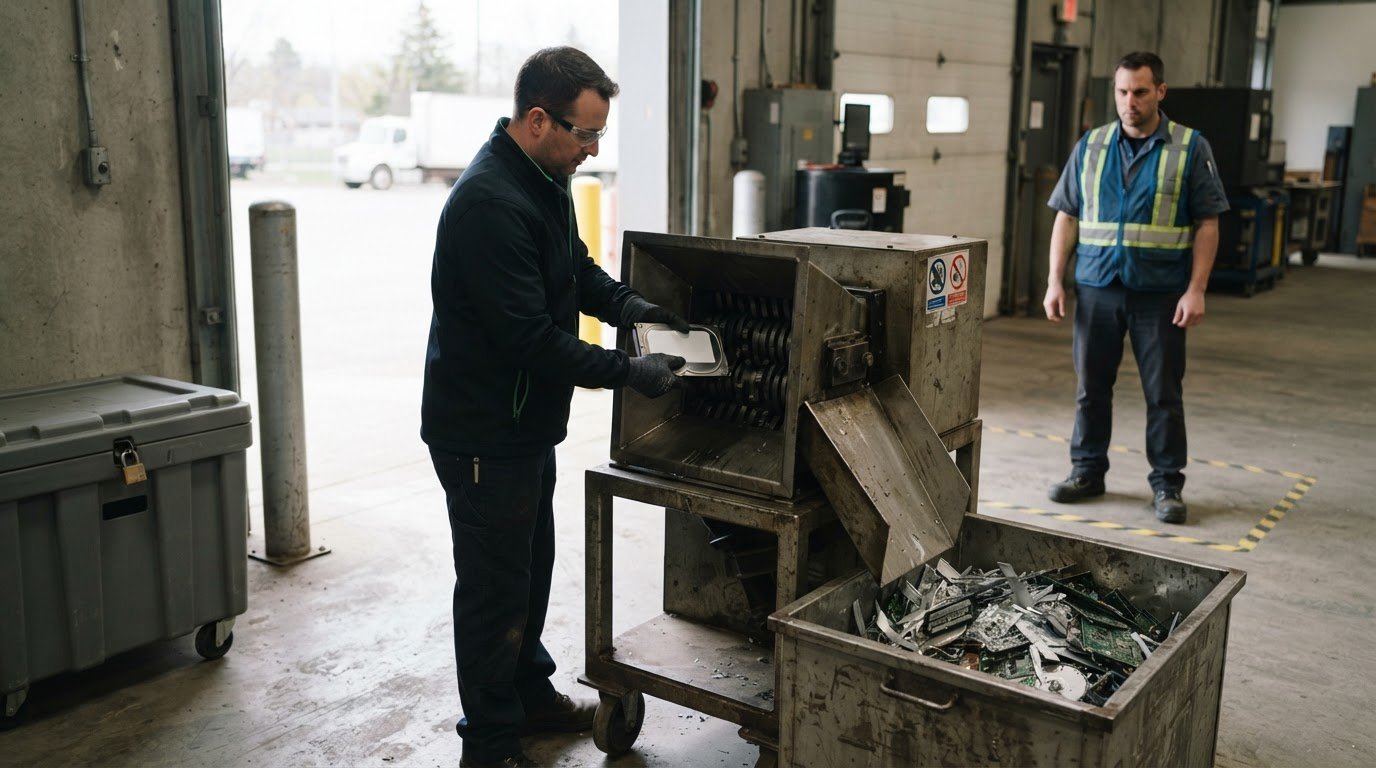
A witness can observe the destruction, but reliable evidence starts before the machine begins. Businesses can arrange to witness on-site hard drive destruction. On-site hard drive shredding witness protocols should specify who observes, what evidence is recorded, and how drives are matched to the inventory. Keep the process under supervision until destruction is complete.
Witnessing can help your team connect each drive to its destruction record. Agree on witness and documentation requirements before processing, then prepare an inventory and arrange site access so the work can proceed smoothly.
This article explains what to expect when witnessing destruction, how on-site service differs from off-site handling, and what to plan for inventory, access, and safety. It also covers how professional hard drive destruction supports secure data handling and responsible electronics recycling.
Key Takeaways
- Set witness and documentation expectations before destruction begins so everyone understands what will be observed and recorded.
- Plan to reconcile drives against an inventory by serial number and retain the destruction certificate with your records.
- Choose on-site or off-site destruction based on your need to observe the process and how you want the equipment handled.
- Prepare the drive inventory and site-access arrangements in advance to support a smooth service visit and responsible electronics recycling.
Can I witness my hard drives being destroyed?
Businesses can arrange to witness on-site destruction in person or by live video. Agree on the witness’s role, observation scope, and records before work begins. Document the on-site hard drive shredding witness protocols alongside the inventory so the witness and service team follow the same plan.
Media Types and Destruction Methods
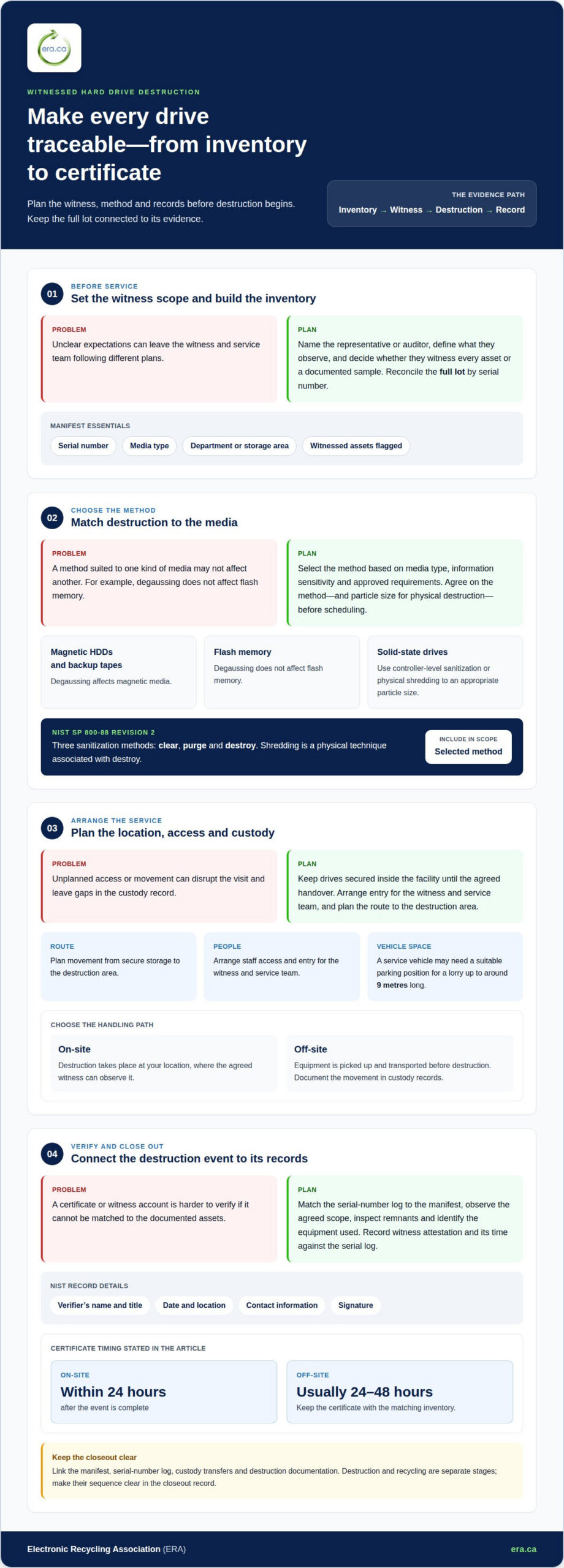
Match the destruction method to the media. Degaussing affects magnetic HDDs and backup tapes, but not flash memory. Solid-state drives need controller-level sanitization or physical shredding to an appropriate particle size. NIST SP 800-88 Revision 2 defines clear, purge and destroy as its three sanitization methods; shredding is a physical technique associated with destroy. Media type and information sensitivity guide selection.
Witness Eligibility in Canada
An organization can designate a representative or auditor as a witness and define their role before service. The customer and auditor decide whether the witness observes every asset or a documented sample; the full lot is still reconciled by serial number. Mobile shredding providers offer witnessed destruction at customer locations in Canada. State who will attend and what the witness is expected to observe.
Destruction Verification and Certificates
Verify completion by matching the serial-number log to the manifest, observing the agreed scope and inspecting remnants. NIST SP 800-88 Revision 2 calls for inspecting remnants and identifying the equipment used. A certificate of sanitization should follow organizational policy. The National Institute of Standards and Technology (NIST) record includes the verifier’s name, title, date, location, contact information and signature.
Sensitive Material and Custody Risks
For classified or highly sensitive IT media, select a method suited to the security category. The Communications Security Establishment leads destruction requirements for IT media. Maintain continuous supervision until destruction is complete, and record custody transfers and witness sign-off. Clear on-site hard drive shredding witness protocols help show who handled each drive and whether the documented destruction process was completed.
How Does Onsite Destruction Differ From Off-Site Destruction?
On-site service means destruction takes place at your location, while off-site service involves transporting the equipment to a facility first. Choose based on whether direct observation or operational convenience matters most.
Provider Certification and Security Checks
NAID certification involves unannounced audits of destruction processes, access controls and methods. Certification and audit records can help organizations assess how a provider manages security. A retail electronics take-back is not, by itself, a record of data destruction. For business drives, distinguish equipment collection and recycling from a documented destruction service, and identify which step produces evidence of destruction.
Ask what records document the completed work and how subsequent handling is recorded. This matters when drives leave the site before destruction or their remains go on to recycling. Destruction and recycling are separate stages, so the closeout record should make their sequence clear.
Chain-of-Custody Documentation
Chain-of-custody records should link the asset manifest, serial-number log, custody transfers, and destruction documentation. For witnessed work, record the witness’s attestation and its time against the serial log. The closeout record should identify the completed destruction and the assets covered, providing evidence from intake through completion.
On-site destruction provides a serialized certificate within 24 hours after the event is complete. Off-site certificates usually arrive within 24–48 hours. These timelines can help teams plan project closeout and records management. Keep the certificate with the matching inventory so the documented lot can be traced later.
With on-site service, destruction takes place at your location, where the agreed witness can observe it. Off-site service involves pickup and transport before destruction, so custody records should document that movement. Choose the option that fits your organization’s evidence needs and site-access requirements.
For a secure pathway that also considers responsible end-of-life handling, explore secure data destruction and electronics recycling. A clear closeout record links the destruction event with the next handling stage, supporting accountable project completion.
How providers plan service scope, inventory, and site access
Plan the appointment around the drive inventory, destruction method, witness arrangements, and facility access. A clear scope helps match the equipment and controls to the work.
Start with an asset manifest that identifies each drive by serial number and media type. Include HDDs, SSDs, and NVMe devices, along with the department or storage area they came from. Flag drives that require witness observation and decide whether the witness will observe every asset or a documented sample. Reconcile the full lot against the manifest.
Method selection depends on media type, data sensitivity and approved requirements. For physical destruction, agree on the required particle size before scheduling. NIST SP 800-88 Revision 2 says organizations must select a suitable method and verify and validate the outcome. Include the selected method in the service scope so the certificate and closeout record match the work performed.
Access planning covers the route from secure storage to the destruction area, staff access and a suitable parking position. A service vehicle may need space for a lorry up to around 9 metres long. Keep drives secured inside the facility until the agreed handover, and arrange entry for the witness and service team. A clear route also helps prevent delays during loading and setup.
Service minimums and scheduling depend on the lot size, equipment needs, site access and witness availability. Confirm the inventory and appointment window together, since a larger lot or restricted facility access can affect the schedule. The price depends on the case and is given after a quote request; relevant factors include drive volume, media types, destruction method, travel and access requirements.
For a recurring program, coordinate each visit around updated inventories and the same access process. Consistent records make it easier to reconcile each cycle and close out the destruction service. Include any changes to the storage location or witness plan before the next appointment.
Hard drive shredding
Shredding physically destroys a hard drive rather than relying on electronic wiping alone. Record Nations describes hard drive shredding as breaking devices into component parts, shredding the pieces and recycling the remains so the data is irretrievable. For an organization, the proper method depends on media type, information sensitivity and the required particle size. These factors help define a suitable destruction scope before service begins.
Scope matters. The service described covers 3.5-inch and 2.5-inch hard disk drives from desktops, servers and storage arrays. A 6 mm commercial particle size is specified for one described process, but it isn’t a universal requirement. DIN 66399 sets seven security levels for data-bearing media, while ISO/IEC 21964 is its international counterpart. These standards help frame the destruction level for a particular volume and security need.
Mobile destruction allows a witness to observe the process at the service location, while a documented manifest connects each drive to the destruction record. Before processing, the service team provides appropriate personal protective equipment and a health and safety briefing. The appointment’s duration depends on the lot size, equipment and site arrangements.
Particle size and device type affect method suitability. Degaussing doesn’t affect flash memory, so solid-state and NVMe drives require controller-level sanitization commands or physical shredding to an appropriate particle size. For high-security shredders and disintegrators requiring 5 mm², the guide states that the RCMP endorses the NSA specification. NIST SP 800-88 Revision 2 also calls for inspecting remnants and identifying the equipment used to verify the result.
After destruction, the remains can enter recycling, linking secure data handling with responsible material recovery. A clear service record identifies the method and equipment used and connects completed work to the inventory. To arrange electronics pickup for retired computer equipment, plan the inventory and site access before scheduling.
Electronic Recycling Association (ERA)
Electronic Recycling Association (ERA) supports Canadian businesses managing retired computer equipment and secure data handling. For organizations planning witnessed hard drive destruction, its secure data destruction can address the information-security step, while electronics pickup and free electronics recycling support responsible equipment recovery.
Equipment suitable for reuse can also support charitable computer donations, extending its value to communities. Considering secure data handling and equipment recovery together helps organizations plan responsibly for end-of-life devices.
Contact Electronic Recycling Association (ERA) to discuss your organization’s electronics and data destruction needs.
Make secure retirement part of your next plan
Build witness arrangements into your organization’s equipment-retirement process instead of treating destruction as an isolated appointment. Clear on-site hard drive shredding witness protocols help align information security, asset records, and responsible handling as equipment leaves service. Planning also helps identify devices suitable for charitable computer donations and those requiring destruction.
Electronic Recycling Association (ERA) provides secure data destruction, electronics pickup, and free electronics recycling. These services help organizations plan for data-bearing equipment and its next step, supporting responsible reuse and recovery where appropriate.
Take the next step for your organization’s retired equipment: Contact Electronic Recycling Association (ERA) to discuss your needs. Each well-planned handover contributes to more secure information handling and a more thoughtful approach to electronic equipment.
Frequently Asked Questions
Can I watch my hard drives being shredded?
Businesses can arrange to observe on-site destruction in person or by live video. Agree in advance whether you’ll witness every drive or a documented sample, and identify who may attend. A recorded session is available on request. This lets your organization plan observation around its security procedures.
Can the customer witness onsite destruction?
A customer can designate a representative to witness on-site destruction, and an auditor can help define the observation scope. Identify the witness and their role before service, including whether they’ll observe every asset or an agreed sample. Advance planning helps coordinate attendance, access, and documentation.
Can you watch your documents being shredded?
A business can arrange to observe document shredding when the service includes a witness plan. Identify the documents covered and the observation process before the appointment. Paper and hard-drive destruction involve different materials and records, so specify what is being processed. This helps ensure the witness observes the relevant work and the closeout record reflects it.
Is on-site shredding compliant with PIPEDA, PHIPA and FIPPA?
On-site shredding alone does not establish compliance with PIPEDA, PHIPA, or FIPPA. PIPEDA requires Canadian businesses to use reasonable safeguards when disposing of personal information. Applicable privacy obligations, information sensitivity, destruction methods, and records all matter. Treat destruction as one part of a broader privacy program, not a substitute for assessing your organization’s requirements.
What is the on-site hard drive shredding process in Canada?
Start by identifying the media, destruction method, witness arrangements, and required closeout evidence. The service team then processes the identified drives at the agreed location while the organization’s representative observes the planned scope. After destruction, records link the completed work to the asset inventory. Include drive type and information sensitivity in the service plan to guide method selection.
What witness protocols should a provider follow during on-site hard drive shredding?
Define the witness scope before work begins, maintain supervision through completion, and record the witness’s attestation and its time against the asset log. Provide appropriate protective equipment and a health and safety briefing before observation. If a drive does not match the inventory, resolve the discrepancy before processing it. These controls link the witness’s observations to the asset record and destruction evidence.