

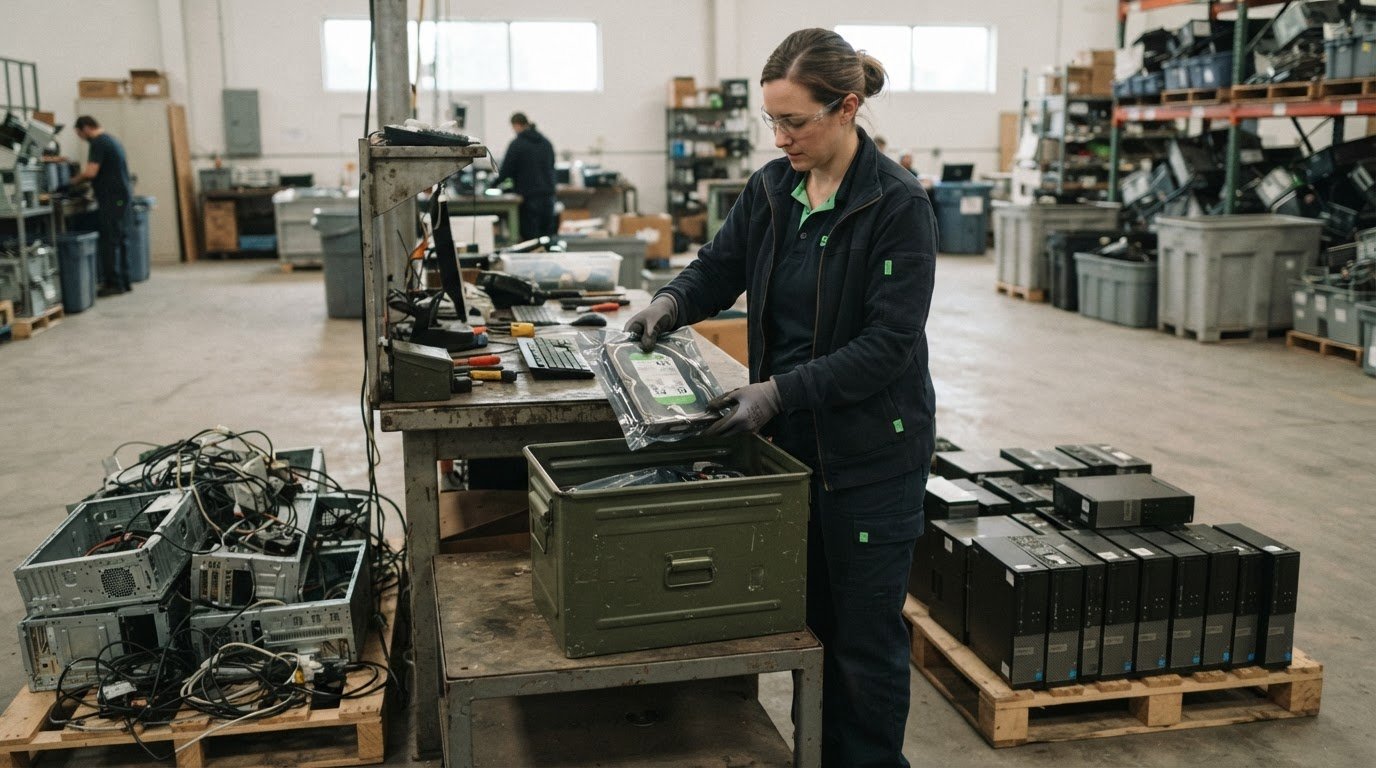
A retired office computer carries two responsibilities: protecting the information it holds and keeping useful materials in circulation. Business electronics recycling involves collecting and sorting equipment, assessing whether it can be reused, and directing end-of-life items for material recovery. Devices that store data need secure wiping or destruction, and a data destruction certificate documents that work.
For businesses and municipalities, the right approach depends on the equipment, its volume and whether devices could be reused by charitable organizations. A certificate helps document the disposal process for internal records, while responsible recycling keeps electronics out of the waste stream and can give working computers a second life.
This guide explains how electronics recycling works, what data destruction certificates document, and how to choose an approach suited to an organization’s needs. It also covers practical options for business and municipal equipment, so you can plan a secure next step.
Key Takeaways
- Separate equipment that may be suitable for reuse from end-of-life devices so each can follow an appropriate recovery path.
- Account for provincial electronics stewardship rules and product categories when planning an organization’s recycling process.
- Match collection and transport arrangements to the equipment volume, type and destination, including appropriate drop-off options.
- Use data destruction documentation to support records of how information-bearing devices were handled.
How does e-waste recycling work?
Electronics recycling sorts equipment for reuse or material recovery, reducing waste and conserving resources. Across Canada, programs differ by jurisdiction in accepted products, fee structures and collection arrangements.
Environmental and handling fees
Environmental handling fees help fund electronics recycling programs and may be associated with purchasing new products. The amount and how it is presented depend on the program and product category. These fees are distinct from a provider’s collection or processing charges, so organizations should identify which applies at each stage.
Some provincial programs include an environmental handling fee in the advertised price when it is passed on to the purchaser. The amount and presentation depend on the applicable program and electronic product. For business planning, identify device categories first, then account for the relevant fee structure.
Environmental and OEM compliance
Environmental compliance means directing equipment through appropriate collection and processing channels. Sorting supports reuse where possible and material recovery for end-of-life devices, helping reduce demand for newly sourced resources. Electronics discarded with ordinary waste can also release harmful materials into the environment.
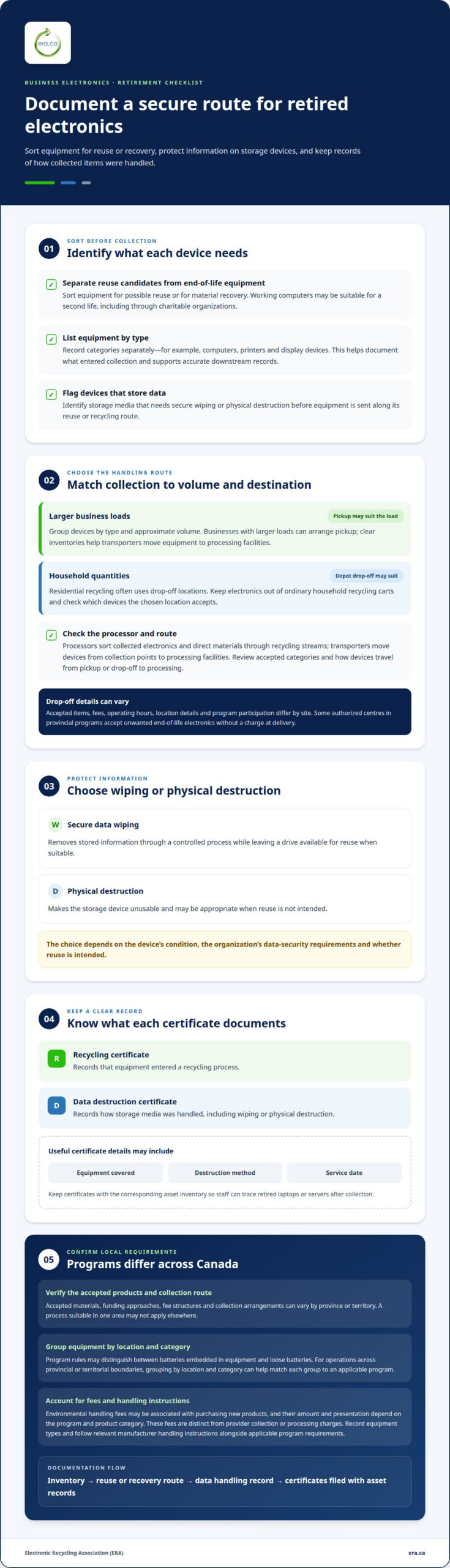
OEM means original equipment manufacturer. Organizations can record equipment types and follow relevant manufacturer handling instructions alongside applicable program requirements. For example, listing computers, printers and display devices separately helps document what entered collection and supports accurate downstream records without treating every item alike.
Provincial and territorial program differences
Across Canada, electronics recycling programs differ by jurisdiction. Accepted materials, funding approaches, fee structures and collection routes can vary, so a process suitable in one area may not apply elsewhere.
For example, program rules may distinguish between batteries embedded in equipment and loose batteries. Organizations operating across provincial or territorial boundaries can group equipment by location and category, then match each group to the applicable program. This makes collection planning clearer and helps equipment reach an appropriate recycling route.
How are Electronics Recycled?
Recycling routes depend on equipment type, volume and the program serving its location. Sorting devices and matching them to suitable collection and processing routes helps separate reusable equipment from materials for recovery.
Qualified processors and transporters
A processor receives collected electronics, sorts equipment and directs materials through appropriate recycling streams. Transporters move devices from collection points to processing facilities, so clear inventories and careful handling support continuity at each stage. Businesses with large volumes can review processor lists to identify operators that may accept their equipment.
Program requirements can offer a useful measure of processor oversight. Recyclers in the Electronic Recycling Association (ERA) program are audited against strict requirements, which incorporate internationally recognized standards. Organisations should consider accepted equipment categories and how devices move from pickup or drop-off to processing.
Authorised drop-off locations
Residential recycling often uses drop-off locations, while business collection may need to account for larger volumes and varied equipment. Keep electronics out of ordinary household recycling carts. Some listed drop-off locations accept electronics without belonging to a provincial stewardship program, so accepted items and program participation can differ by location.
Authorised drop-off centres in some provincial programs accept unwanted end-of-life electronics without a charge at delivery. Elsewhere, accepted devices and locations vary by program. Separating equipment by type before choosing a route helps avoid mixing electronics with ordinary waste or bringing items to an unsuitable site.
For pickup and drop-off planning, group devices by type and approximate volume, then match them to a collection route. Businesses with larger loads can arrange pickup, while households can use a depot drop-off. This distinction helps organisations and municipalities coordinate collection and keep electronics out of landfills.
Where equipment is accepted through a provincial recycling program, follow that program’s collection route. At other electronics drop-off locations, accepted items, fees, operating hours and location details can differ. Reviewing those details before delivery helps prevent an unnecessary trip and keeps each device moving toward appropriate reuse or recycling.
Do you provide certificates of recycling/data destruction?
A certificate can document the handling of collected electronics and data-bearing devices. Before collection, equipment is sorted for reuse or recycling, and devices requiring data wiping or physical destruction are identified.
Recycling and data destruction certificates
A recycling certificate records that equipment entered a recycling process; a data destruction certificate records how storage media was handled. These documents support an organization’s internal asset and privacy records. Useful details may include the equipment covered, destruction method and service date. Keep the records with the corresponding asset inventory so staff can trace retired laptops or servers after collection.
Secure data wiping and physical destruction
Data wiping removes stored information through a controlled process while leaving a drive available for reuse when suitable. Physical destruction makes the storage device unusable, which may be appropriate when reuse is not intended. The right route depends on the device’s condition, the organization’s data-security requirements and whether equipment can be reused. Record the chosen method for each device category.
For business electronics recycling, start by inventorying equipment and identifying data-bearing devices. The collection provider can use that information to organize pickup, distinguish reusable computers from end-of-life equipment, and direct storage media for wiping or destruction. A laptop and a retired server may need different handling, so clear identification supports responsible processing.
Personal or sensitive information should be removed before electronics are dropped off for recycling. For business equipment, data removal should be part of the provider’s documented process, rather than an assumption based on a device’s age or condition. Deleting a file or resetting a device is not the same as a documented data destruction process.
After collection, match the certificate to the devices it covers. Retain it alongside the inventory and disposal records, and keep collection details connected to the equipment batch. This creates a practical record of what was accepted, how data-bearing devices were handled and which electronics proceeded to recycling or reuse.
Business and municipal electronics recycling solutions
Canadian recycling programs can accept business equipment such as computers, servers, laptops, tablets, printers, copiers, scanners, fax machines and display devices. Audio-visual, telecommunications and music electronics are also included in some program categories.
For corporate offices and municipalities, the practical route depends on equipment type, volume, condition and potential for reuse. Working computers may be suitable for charitable donation, while end-of-life equipment can proceed to recycling.
A coordinated electronics recycling program helps organizations manage equipment from multiple departments. Municipalities can organize retired devices from offices, libraries or facilities, while businesses can consolidate equipment from separate work areas. An inventory grouped by type helps identify computers for donation and equipment requiring recycling.
Consider the full equipment stream, not only desktop computers. An office refresh may include printers, monitors, laptops and servers, while a municipal project may also involve telecommunications equipment. Grouping items by category supports collection planning and makes reuse decisions easier to track.
Community reuse can strengthen a municipal or corporate program. Working computers may be donated to charities, extending their useful life and supporting community needs. Devices that cannot be reused can still enter appropriate recycling streams, helping keep electronic waste out of landfills.
Plan collection around how equipment is distributed across the organization. A central collection point helps departments prepare retired items together, while an inventory distinguishes reusable computers from end-of-life devices. This coordination makes it easier to include electronics retirement in routine asset planning.
Start by grouping equipment by category, volume and reuse potential, then arrange a collection route suited to the organization’s needs. For a practical next step, arrange electronics pickup for business or municipal equipment and help keep reusable computers in service.
Electronic Recycling Association (ERA)
Electronic Recycling Association (ERA) helps organizations across Canada manage retired electronics through recycling, secure data destruction and pickup. Computers suitable for reuse can enter ERA’s charitable donation program, extending their service and supporting community needs. These options bring equipment handling, information security and community benefit into one practical plan.
ERA states that it is certified to ISO/IEC 27001, ISO 9001, ISO 14001 and ISO 45001 standards. Businesses and municipalities can turn to ERA when they need a coordinated route for surplus computers or other electronics, including secure handling of data-bearing devices. The right approach depends on equipment condition, data requirements and whether items can be reused.
Contact Electronic Recycling Association (ERA) to discuss recycling your organization’s electronics.
Make equipment retirement part of your plan
Set a clear process for equipment at the end of its working life. Assign responsibility for identifying retired devices, recording their destination and keeping related records together. A consistent approach helps departments act promptly instead of letting unused computers accumulate in storage.
For the next equipment refresh, include responsible handling in the planning conversation. Consider which devices may still be useful, which require secure data handling and how collection fits the organization’s operations. Planning ahead makes business electronics recycling easier to incorporate into routine asset decisions while preserving options for reuse and responsible recovery.
Electronic Recycling Association (ERA) offers free electronics recycling, secure data destruction and electronics pickup for organizations managing retired equipment. Contact Electronic Recycling Association (ERA) to discuss a practical next step for your organization’s electronics.
A thoughtful retirement plan can protect information and contribute to a more resource-conscious community.
Frequently Asked Questions
Do I have to pay a fee when I drop off my old electronic equipment?
It depends on the program and jurisdiction. In New Brunswick, unwanted end-of-life electronics can be dropped off at authorized centres without a drop-off charge; the Environmental Handling Fee is associated with purchasing new products. ERA’s standard donations and pickups are free. Larger operations or specialized requirements may involve fees, which are disclosed beforehand. Distinguish a program handling fee from a recycling provider’s charge.
How can a business ensure its data is secure when a recycling provider handles its electronics?
Choose a defined data-handling route and keep records that connect devices to that process. ERA provides data wiping and physical hard-drive destruction, including on-site destruction using mobile “AmeriShred” shredders. For example, an organization retiring laptops for reuse can arrange wiping, while highly sensitive drives can be directed for physical destruction. Keep the resulting service documentation with the relevant equipment records to support internal accountability.
How can a business arrange electronics disposal through a recycling provider?
Prepare an equipment inventory, then arrange pickup or depot drop-off with a provider that handles organizational electronics. ERA offers pickup and drop-off options for equipment such as computers, printers and servers. Grouping items by type and identifying data-bearing devices helps the provider plan collection and data handling. For larger or specialized operations, clarify the required logistics and reporting before the collection is arranged.
What business electronics recycling services are available in Canada?
Organizations can use electronics collection, recycling, secure data destruction, reuse and donation pathways. ERA provides free standard electronics recycling, pickup, data destruction and charitable computer donations. Accepted equipment includes computers, laptops, printers, scanners, servers, peripherals and phone systems. A business retiring working computers alongside outdated printers can separate potential donations from equipment proceeding directly to recycling.
What are the Canadian regulations for recycling business electronics and e-waste?
Electronics recycling programs differ across provinces and territories, so requirements depend on where equipment is collected and which program applies. Product categories, accepted materials, collection routes and fee structures can vary. For instance, Alberta and New Brunswick operate distinct program frameworks. Organizations planning a multi-jurisdiction equipment retirement should map inventory and collection locations to the relevant provincial or territorial program.
Do businesses need data destruction or certificates when recycling computers and phones?
Businesses should treat data removal as a separate decision from recycling; whether a certificate is required depends on organizational policies and applicable obligations. A certificate can document the handling method and equipment covered, supporting records for retired computers or phones. ERA provides secure data destruction, including wiping and physical hard-drive destruction. Keep documentation with asset disposal records so the process remains traceable.