

Why End-of-Life Drives Are a Data Security Problem, Not a Recycling Afterthought
A single retired laptop sitting in a storage closet still holds every payroll record, client file, and saved password it carried on its last working day. Reformatting the disk or deleting the visible files does almost nothing to remove that data, and security researchers have spent years buying used drives at auction and pulling intact financial records, patient files, and corporate email off them. For any Canadian organization retiring computers, servers, or phones, the device stops being an IT asset and becomes a question of who gets to read what was left behind.
That shift in thinking changes how you evaluate a vendor. A recycler who hauls away your old equipment and quietly resells the working units is not the same as a provider who treats every drive as a containment problem until the data is verifiably gone. The gap between those two approaches is where breaches happen. A secure hard drive destruction service exists to close that gap, proving the information left behind can never be rebuilt.
The Electronic Recycling Association built its data security work around that exact standard, partnering with Canadian law enforcement to show how easily neglected drives leak sensitive information. The standards below are worth demanding before you hand anyone a pallet of end-of-life equipment.
Physical Destruction Versus Software Wiping
Two methods dominate end-of-life data removal, and they serve different needs. Software erasure overwrites the contents of a drive so the original data cannot be read back, leaving the hardware intact and reusable. Physical destruction shreds the drive into fragments, ending its life but removing any doubt. A capable provider offers both and helps you decide which fits each batch of equipment rather than forcing one method onto everything.
The right choice comes down to how sensitive the data is and what you plan to do with the hardware afterward. Drives bound for reuse call for verified wiping, while drives that held regulated records often call for shredding. Knowing where that line sits keeps you from paying to destroy reusable machines or under-protecting data that should never survive intact.
When Software Erasure Does the Job
Software erasure is the right call when the goal is to reuse working equipment without leaving recoverable data behind. The method overwrites every sector of a drive several times with random patterns, so the files, fragments, and deleted material that ordinary formatting leaves untouched are genuinely gone. Done properly, the drive reaches its next owner as a clean slate while staying fully functional.
ERA applies this approach to all equipment slated for refurbishment, running a multiple pass, random array routine across each disk with industry leading software. That matters for cost as much as security, since a wiped laptop can keep serving a school or charity instead of becoming scrap. Organizations that want to handle low-risk drives themselves before donation can use free open source tools such as DBAN to overwrite a disk at no charge, though those tools lack the reporting a managed process provides. The trade-off is verification. Doing it yourself saves money but leaves you without the documentation an auditor may later want to see.
When Only Shredding Is Defensible
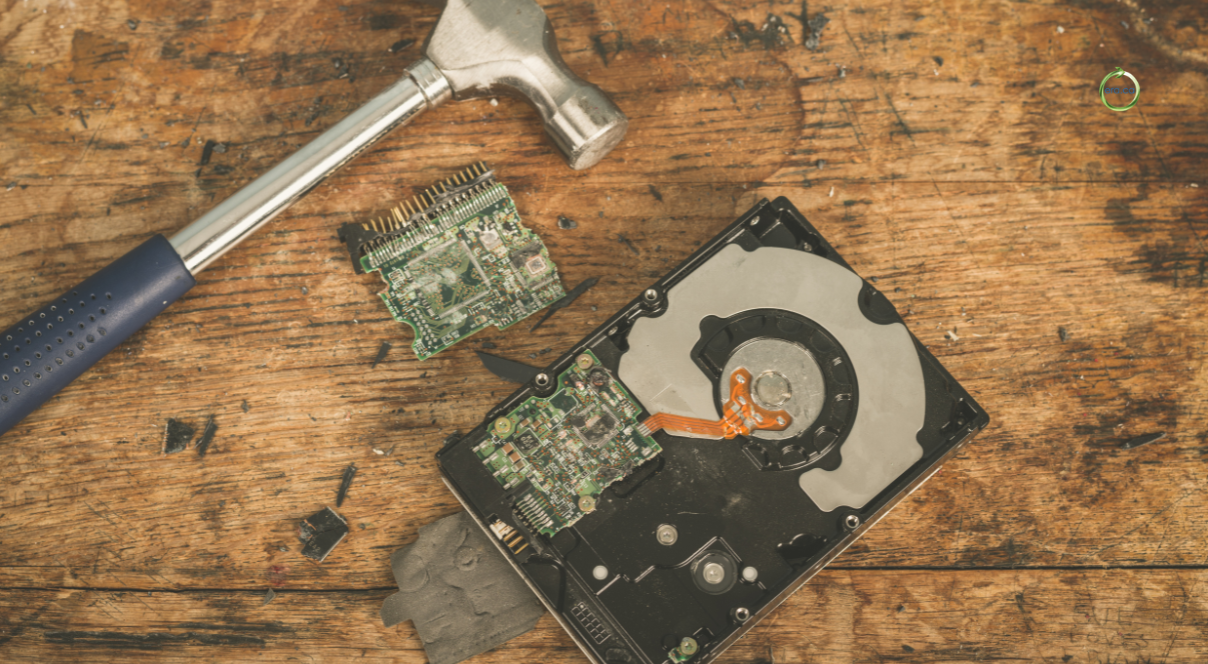
Physical shredding becomes the defensible choice the moment a drive held data you cannot afford to see resurface. Patient records, financial files, legal holds, and government information often fall under rules where a wiped drive still carries unacceptable risk, and where a shredded drive ends the matter. Once the platters and chips are reduced to fragments, no recovery lab can rebuild what was there.
A serious hard drive destruction service runs industrial shredders built for the work rather than office equipment that mangles a few units a day. ERA operates AmeriShred mobile shredders that chew through hard drives, solid state drives, data tapes, and full servers, turning storage hardware into unreadable scrap in seconds. Cost plays a role here too. Some specialized wiping software is expensive enough that for a one-time project, shredding a stack of drives is faster and cheaper than licensing a tool to sanitize them. When the data is sensitive and the hardware has reached the end of its useful life anyway, destruction is the cleaner answer.
On-Site and Off-Site Destruction, and Why the Difference Matters
The difference between on-site and off-site destruction comes down to one question. Where are your drives when they are destroyed, and how far do they travel as intact, readable hardware before that happens. Off-site destruction means a provider collects your drives and shreds them at a secure facility. On-site destruction means the shredder comes to you, and the drives never leave your property in one piece.
Both can be done securely, and both end with documentation, but they carry different risk profiles. Off-site collection is practical for large volumes and lower-sensitivity equipment, since a tracked pickup and a controlled facility handle the work efficiently. With ERA, representatives from the originating company are welcome to watch the destruction in person at its facilities, or request a live or recorded video of the process. On-site destruction removes the transit window entirely, which is why compliance-driven organizations often prefer it. You can read more about how ERA structures its secure data destruction process across both formats. The right pick depends on volume, sensitivity, and how much transit risk your policies allow.
Mobile Shredding That Keeps Drives on Your Premises
On-site mobile shredding lets your team watch sensitive drives turn to fragments without a single unit leaving the building intact. ERA brings a mobile shredder to your facility, and its staff destroy the drives where they sit, which closes the gap that worries most compliance officers. For some organizations, even that is not enough separation, and the rules require that no outside hands touch the media at all.
For those cases, ERA rents its AmeriShred mobile units directly. A representative delivers the unit, demonstrates safe operation, and then hands off to your own cleared staff so your people perform the destruction personally. The drives stay under your physical control from the first cut to the last, which suits banks, healthcare providers, and government bodies whose protocols forbid sensitive material from leaving the premises. It is the strictest custody model available, and it puts the final act of destruction in the hands of the people who own the data.
Chain of Custody From Collection to Final Destruction
A secure provider can account for every drive from the moment it leaves your hands to the moment it is destroyed, with no unexplained gaps in between. Chain of custody is the documented trail that proves your equipment was tracked, never set aside, and never quietly diverted. Without it, you are taking a vendor’s word that nothing went missing, which is no defense if a drive surfaces later.
A strong chain of custody starts at collection. The provider should log what it picks up, ideally capturing make, model, and serial number, so the inventory leaving your site matches the inventory that gets destroyed. ERA can issue a Collection Certificate and a Collection Inventory Spreadsheet that record exactly that, giving you a baseline to reconcile against the final destruction record. When you schedule a pickup of retired equipment, that logging is where accountability begins. Every drive that leaves your office should be traceable to a documented endpoint, and any provider who cannot show you that trail should not be handling regulated data.
The Certificate of Destruction and the Paper Trail Behind It
A Certificate of Destruction is the document that proves your data was destroyed, and it is only as good as the detail it carries. A vague certificate stating that some drives were shredded on some date offers little protection in an audit or a breach investigation. A useful one names what was destroyed, when, and by whom, in terms specific enough to hold up to scrutiny.
ERA issues a Certificate of Destruction that lists the individual serial numbers of the units destroyed, so the document ties directly back to the equipment you handed over. That specificity is what turns a piece of paper into evidence. Many regulated industries require this kind of record to show that end-of-life data was handled correctly, and keeping it on file is often the difference between demonstrating due diligence and scrambling to reconstruct what happened. Treat the certificate as a core deliverable, not a formality you remember to request after the fact.
Serial Number Reporting Auditors Will Ask For
Serial number reporting is the detail auditors reach for first, because it lets them match a destroyed drive to a specific asset in your records. A count of units tells them how many drives died. A list of serial numbers tells them which ones, and that distinction matters when a regulator wants proof that one particular machine was handled correctly.
Beyond the destruction certificate itself, ERA can provide a layered set of documents depending on what your compliance program needs. A Collection Inventory Spreadsheet captures make, model, and serial number at intake. A Data Wipe Certificate covers drives that were sanitized rather than shredded. A Donation in Kind Certificate records equipment routed to charitable reuse. Together these records let an organization close out an IT asset disposal project with a clean, defensible file rather than a folder of guesswork. Ask any provider which documents they issue as standard and which require a special request, because the answer reveals how seriously they take accountability.
Certifications a Canadian Provider Should Already Hold
Certifications matter because they prove a provider’s process has been audited by an outside body rather than described in a sales brochure. Anyone can claim to handle data securely. A current ISO certification means an independent assessor has examined how the organization manages information, quality, and risk, and confirmed it meets a recognized international standard.
The certification worth looking for first is ISO/IEC 27001, the standard for information security management, since it speaks directly to how a provider protects the data passing through its hands. ERA holds that certification alongside ISO 9001 for quality management, ISO 14001 for environmental management, and ISO 45001 for occupational health and safety, which together cover security, consistency, environmental responsibility, and worker protection. You can review the full set of ERA’s certifications and accreditations before committing to a provider. A vendor without recognized certifications is asking you to trust claims no one has checked, and for regulated data that is a risk most organizations cannot justify.
Privacy Laws That Set the Bar in Canada
Canadian privacy law makes secure disposal an obligation, not a courtesy. Under the federal Personal Information Protection and Electronic Documents Act, known as PIPEDA, organizations are responsible for safeguarding personal information throughout its lifecycle, and that responsibility does not end when a device is retired. Several provinces add their own statutes on top, including private-sector laws in British Columbia, Alberta, and Quebec, and health-specific rules in provinces such as Ontario. Many of these frameworks also carry breach reporting duties, which means a mishandled drive can turn into a reportable incident with regulators and affected individuals.
What these laws share is an expectation that you protect personal data until it is properly destroyed, and that you can show you did so. The exact obligations vary by province, sector, and the type of information involved, so confirming your specific duties with qualified legal counsel is the safe path. From a vendor selection standpoint, the practical takeaway stays consistent. Choose a provider whose documentation and methods let you demonstrate compliance if a regulator ever asks. A destruction process that produces serial-level records and verifiable certificates makes that far easier than one that leaves you reconstructing events after the fact.
The Full Range of Media a Service Should Be Able to Destroy
A capable provider can destroy far more than the spinning hard drives people picture first. Modern data lives on solid state drives, inside servers, on backup tapes, in phones, and on optical discs, and each format needs equipment that can physically break it down. A service that only handles standard hard drives leaves the rest of your retired technology as an open question.
ERA’s AmeriShred shredders are built to process hard drives, solid state drives, data tapes, servers, and other storage hardware, which covers the bulk of what most organizations retire. Solid state media deserves particular attention, since the way it stores data makes some software wiping methods unreliable, and physical destruction is often the surer route. If your inventory includes unusual formats such as legacy tape systems or proprietary storage units, confirm the provider can handle them before scheduling the job rather than discovering a gap on the day of pickup. The goal is a single accountable process for every piece of data-bearing equipment, not a patchwork of vendors for different media types.
Witnessed Destruction and Independent Verification
You should be able to watch your drives die, either in person or on video, whenever the data warrants that level of assurance. Witnessed destruction removes the trust gap entirely, because you are no longer relying on a certificate to tell you something happened. You saw it happen, or you hold a recording that did.
ERA invites representatives from the originating company to observe destruction in person at its facilities, and offers a live or recorded video of the process for teams who cannot travel to watch. That option is built for compliance officers and legal departments who need verification without sending someone across the country. The same transparency shows in ERA’s work with Canadian law enforcement, including a partnership with the North Vancouver RCMP that demonstrated industrial shredding to the public as part of a wider effort to raise awareness about the data risks tied to discarded devices. When a provider is comfortable being watched, it usually means the process holds up to watching. For high-stakes disposals, that recorded proof becomes part of the same evidence file as the certificate and the inventory, giving your compliance team a complete account of how each drive met its end. Independent verification of that kind is what separates a provider you trust on faith from one you can defend in front of an auditor or a court.
What Happens to the Shredded Material Afterward
Secure destruction should not trade a data problem for an environmental one. Once a drive is shredded, the fragments still contain metals, plastics, and circuitry that belong in a recovery stream rather than a landfill. A responsible provider tracks where that material goes and keeps it out of the waste system, so your security decision also supports a cleaner outcome.
This is where ERA’s structure stands apart from a pure destruction vendor. As a non-profit recycler, the organization routes destroyed material toward proper recovery, where metals and other components can re-enter manufacturing rather than sitting in the ground leaching contaminants. Its ISO 14001 certification for environmental management reflects that the disposal side is handled to a recognized standard, not left to chance. For organizations with sustainability commitments of their own, that matters, because the destruction record and the environmental record come from the same accountable process. Asking a provider what happens to the shredded remains is a fair question, and a thin answer tells you something about how the rest of their operation runs.
Balancing Secure Destruction With Responsible Reuse
Not every drive needs to be destroyed, and a thoughtful provider helps you separate the ones that do from the ones that can safely live on. Shredding a perfectly good laptop that only held low-sensitivity data wastes working hardware someone else could use. Verified wiping lets that machine pass to a new owner clean, while destruction stays reserved for the equipment that truly demands it.
ERA was built around this reuse-first idea. Working devices are wiped, refurbished, and donated to charities, schools, healthcare facilities, and community groups across Canada, while only the most sensitive or unusable equipment is physically destroyed. The fear of leftover data is the single biggest reason organizations hesitate to donate, and a strong wiping process removes that hesitation. You can see the kinds of organizations that receive refurbished devices through the program. Pairing secure data handling with reuse means your retired technology can protect your information and still do some good, instead of ending its life as shredded scrap when it never had to.
The Questions Worth Asking Before You Sign
A handful of direct questions will tell you quickly whether a provider meets the bar. Ask which destruction methods they offer and how they decide between wiping and shredding, since a one-size answer suggests they are selling a process rather than fitting one to your needs. Ask what documentation comes standard and what requires a special request, because the gap between those two reveals their default level of accountability.
From there, ask how they maintain chain of custody, whether you can witness destruction, and which certifications they currently hold. A capable hard drive destruction service will answer each of these without hesitation and back the answers with records you can keep on file. Ask what happens to the material afterward, and whether reuse is an option for equipment that does not need destroying. Ask about media beyond standard drives, so solid state units, tapes, and servers are all covered. A vendor who treats these questions as routine is usually one who has built a process worth trusting.
Choosing a Destruction Partner You Can Stand Behind
The right partner makes secure disposal simple to prove and easy to defend, backed by audited methods, serial-level records, and the option to watch the work happen. The Electronic Recycling Association brings all of that together with a Canada-wide footprint and a reuse-first mission that keeps working devices in service. For a hard drive destruction service that protects your data and your community at once, reach out to ERA’s data security team to find the approach that fits your organization.