


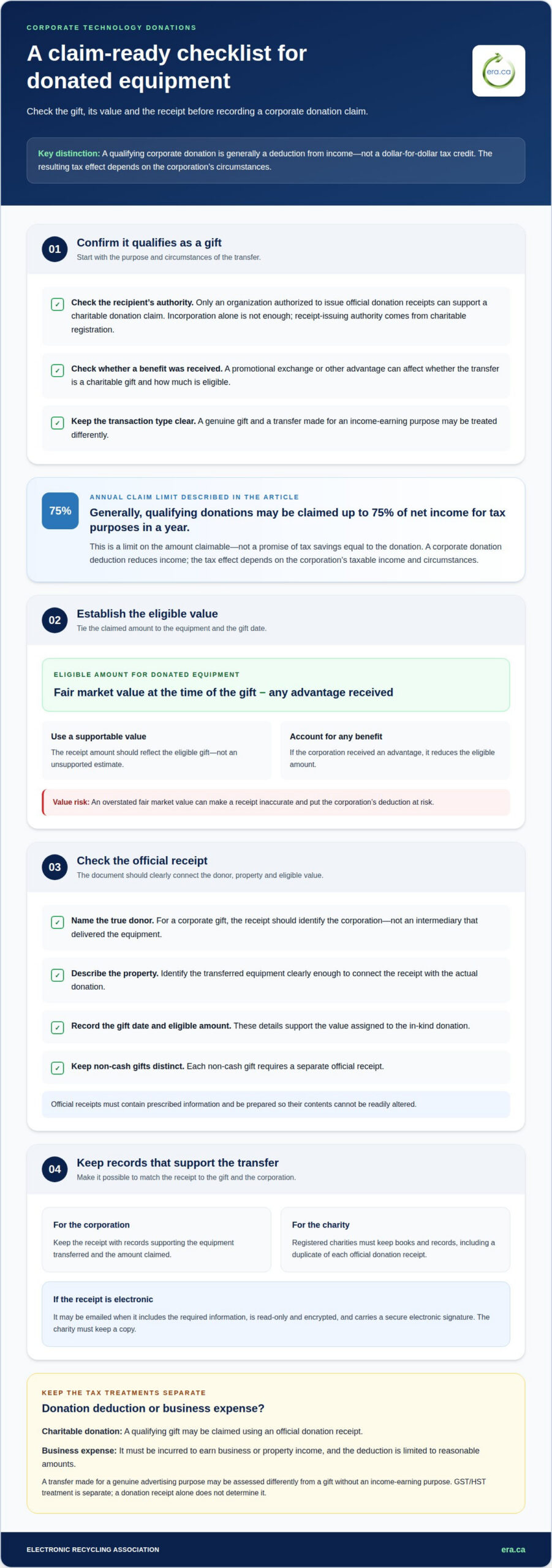
A corporate technology donation can reduce taxable income, but it doesn’t create a dollar-for-dollar tax credit. CRA tax receipts for corporate technology donations support a deduction from corporate income when the gift qualifies; according to the Canada Revenue Agency, qualifying donations are generally claimable up to 75% of net income for tax purposes in a year. For donated equipment, the eligible amount is generally its fair market value at the time of the gift, less any advantage received.
It’s reasonable to want a clear figure before donating computers or other equipment. The receipt amount and tax savings are not necessarily the same: a corporate donation deduction reduces taxable income, and the resulting tax effect depends on the corporation’s circumstances.
This article explains how eligibility and fair market value shape a claim, when business expense rules may apply, and what official receipts need to establish. You’ll learn to distinguish a charitable donation deduction from an expense claim, so your contribution can support community needs and your records accurately reflect the transaction.
Key Takeaways
- Separate a charitable donation deduction from a business expense claim; the purpose and circumstances of the transfer affect how it is treated.
- Confirm that an official receipt comes from an organization authorized to issue one, and that it identifies the true donor.
- Assess whether donated equipment qualifies as a gift and how any benefit received affects the eligible amount.
- Understand how charitable computer donations can give usable technology a community purpose while supporting responsible equipment retirement.
Business expense deductibility versus charitable donation tax credits
A technology transfer may count as a charitable gift or a business expense, depending on its purpose and circumstances. That distinction affects how a corporation records the transaction and calculates its claim.
Corporate Charitable Donation Claims
Under section 110.1 of the Income Tax Act, a corporation may claim a qualifying charitable donation using a donation receipt. According to the Canada Revenue Agency, individuals and corporations generally may claim qualifying charitable donations up to 75% of net income for tax purposes annually. This deduction reduces income, rather than providing a dollar-for-dollar credit, so its tax effect depends on the corporation’s taxable income.
For CRA tax receipts for corporate technology donations, records should connect the receipt to the equipment transferred and the corporation that made the gift. A business expense follows a different test: it must be incurred to earn business or property income, and section 67 limits deductions to reasonable amounts. A transfer made for a genuine advertising purpose may be assessed differently from a gift without an income-earning purpose.
Tax Rules for Technology Donations
GST/HST treatment is separate from the income tax deduction. A donation receipt alone does not determine GST/HST treatment; the transaction and the recipient’s circumstances matter. Provincial and territorial tax rules can affect a corporation’s overall tax calculation, while a charitable claim still depends on an eligible gift and a valid receipt.
For example, distinguish a direct gift from a transfer made in exchange for a promotional benefit. That difference can affect whether the transaction is treated as a charitable donation or a business expense, and how the corporation documents it.
Risks of Overstated Values and Improper Receipts
An overstated fair market value can make a receipt inaccurate and put the corporation’s deduction at risk. The amount should reflect the eligible gift, not an unsupported estimate. If a charity issues improper receipts, the Canada Revenue Agency can suspend, revoke, or annul its charitable status.
An organization’s legal form alone may not be enough to issue official donation receipts. Under subsection 230(2) of the Income Tax Act, a registered charity must keep records and books of account, including a duplicate of each official donation receipt. Accurate records support both the receipt and the corporation’s claim.
CRA authority to issue official donation receipts
Only organizations authorized to issue official donation receipts can support a charitable donation claim. For a technology gift, an accurate receipt identifies the donor, the property transferred, and its eligible value.
Required Receipt Contents
Official donation receipts must contain prescribed information and be prepared so their contents cannot be readily altered. Subsection 3501(1) of Canada’s Income Tax Regulations sets this requirement, helping donors keep a usable record for federal tax reporting.
Under regulation 3501 (1h), a charity may issue an official receipt when a transfer of property constitutes a gift for tax purposes. For donated technology, the receipt should identify the true donor and describe the property clearly enough to connect the document with the transfer. Each non-cash gift requires a separate receipt.
For non-cash property, the eligible amount is its fair market value when the gift is made, less any advantage received. This gives the corporation a documented basis for its claim.
Corporate Donor Receipts
A corporate donor needs a receipt that records the corporation as the donor, not an intermediary that delivered the equipment. The charity’s receipt identifies the true donor, and the corporation keeps it with records supporting the transfer and claimed amount.
Incorporation alone does not authorize an organization to issue official donation receipts. That authority comes from registration as a charity. The Canada Revenue Agency maintains a list of qualified donees that can issue receipts.
Before relying on a receipt for a corporate claim, distinguish a qualifying gift from a transfer involving a benefit. A receipt documents the charitable gift; it does not turn a purchase or promotional exchange into one.
Electronic Receipts and In-Kind Documentation
Canadian charities may email official donation receipts when they include required information, are read-only and encrypted, and carry a secure electronic signature. The charity must keep a copy. The CRA’s policy CPS-014 permits computer-generated receipts when they are readable and data-entry reliability is sufficiently protected.
For an in-kind technology donation, the charity’s documentation should identify the donor and transferred equipment, show the gift date, and state the eligible amount. Subsection 3501(3) permits a facsimile signature, while a computer-stored duplicate does not require a signature.
These records connect the receipt to the property actually transferred and its value. A clear description helps distinguish the donated equipment from other transfers recorded by the charity.
Eligibility to claim donation and gift credits
Eligibility depends on the donor, the recipient organization’s status, and whether the transfer qualifies as a gift. Individuals and corporations report qualifying donations differently for Canadian income tax purposes.
Claiming Credits on Tax Returns
Claiming a donation credit means reporting eligible gifts on an individual income tax return to calculate a non-refundable tax credit. For the 2025 tax year, individuals report donations and gifts on federal line 34900 and use Schedule 9 to calculate the claim.
Provincial or territorial credits may also apply, with provincial or territorial line 58969 used for the 2025 return. A corporation’s qualifying charitable donation is generally claimed as a deduction, not as an individual’s tax credit. Keeping the receipt with the related tax records supports the amount reported.
Donation Claims and Net Income
The annual limit links qualifying donation claims to net income for tax purposes. Individuals and corporations generally may claim qualifying charitable donations up to 75% of net income for tax purposes in a year.
The limit affects how much a donor can claim in the current year, even when eligible gifts exceed it. Unused charitable donation credits may generally be carried forward for five years. A corporation’s deduction reduces income; an individual’s credit reduces tax payable, not taxable income.
Maximum Annual Donation Claim
The maximum annual claim is generally 75% of net income for tax purposes, but the limit differs in a specific situation for individuals. An individual’s annual limit increases to 100% of net income in the year of death or the preceding year.
For a corporation, the general annual 75% limit helps determine how much qualifying giving can be claimed for that year. A gift above the current limit may affect a later return if it qualifies for carry-forward treatment. The recipient’s status and the nature of the property still matter: a receipt alone does not make every transfer eligible.
Eligible amount and split receipting
The eligible amount is the portion of a gift that can support a charitable claim for tax purposes. For technology, it depends on the equipment’s fair market value when gifted and any benefit the donor receives. Understanding CRA tax receipts for corporate technology donations helps separate the equipment’s value from other parts of the transaction.
Eligible Cash and Non-Cash Gifts
Qualifying gifts may include money or property transferred to an eligible organization. Donated computers and similar equipment can qualify when they are genuine gifts to an organization authorized to issue official receipts. Donated services are different: services are not property and do not qualify as gifts for this purpose.
Split receipting separates the gift’s value from any benefit received in return. The charity deducts the value of an advantage when calculating the eligible amount. An advantage may be disregarded when its total value does not exceed the lesser of C$75 or 10% of the gift’s fair market value.
Technology Donation Eligibility
Technology eligibility depends on the recipient, the transfer, and the property’s value. The Canada Revenue Agency’s qualified-donee list identifies organizations that can issue official donation receipts. The receipt and supporting records should describe the equipment actually transferred, not a general estimate of the company’s surplus assets.
CRA tax receipts for corporate technology donations should reflect a gift made by the corporation and the gift’s eligible amount. A transfer made in exchange for a promotional benefit may affect how much qualifies as charitable giving.
Valuing Used or Obsolete Technology
Used, depreciated, or obsolete equipment is valued at its fair market value when the gift is made. Its original purchase price or accounting value does not, by itself, establish its current worth. Consider its condition and current market value.
For donated computers, fair market value means the property’s value when gifted, not its historical cost. This principle applies even when the equipment has been depreciated. Arrange a charitable computer donation to give usable technology a community purpose.
Electronic Recycling Association (ERA): Charitable computer donations
Electronic Recycling Association (ERA) provides charitable computer donations for businesses seeking to redirect technology for community use. If your equipment is no longer needed, this can be a practical next step after you review its tax treatment and document the transfer.
Donated computers can support community needs, while equipment that is not donated can go through free electronics recycling. ERA also provides secure data destruction and electronics pickup, helping businesses manage information security and collection when retiring technology.
Keep tax records separate from equipment-handling arrangements. The eligible amount depends on the gift and its fair market value, and the receipt must come from an organization authorized to issue official donation receipts. For charitable computer donations or related electronics services, contact Electronic Recycling Association (ERA) to discuss your equipment.
Put surplus technology to purposeful use
A corporate technology donation can be more than an end-of-life decision. It can put usable equipment towards community needs and give your organization a clear next step for technology it no longer requires. Keep records aligned with the actual transfer, and treat equipment retirement and tax reporting as connected but distinct responsibilities.
Clear records for CRA tax receipts for corporate technology donations start with a receipt that reflects the property transferred and its eligible value. For equipment that will not be donated, Electronic Recycling Association (ERA) offers free electronics recycling, secure data destruction, and electronics pickup. These options support responsible equipment retirement and information security alongside your organization’s giving goals.
Choose the route that fits your equipment, then contact Electronic Recycling Association (ERA) to discuss the next step. Each responsible decision can help technology serve a useful purpose beyond your workplace.
Frequently Asked Questions
How much can I claim on my tax return?
For a corporation, the amount claimed is the eligible value of the gift, subject to the applicable income limit. Qualifying donations are generally claimable up to 75% of net income for tax purposes in a year. The deduction reduces taxable income, so the tax savings depend on the corporation’s taxable income and applicable tax rate. The receipt amount is not the tax savings itself.
Individual receipts or annual receipts?
A charity may issue one cumulative receipt for recurring cash gifts made during the year, rather than a separate receipt for each payment. This can simplify recordkeeping for individuals who contribute regularly. Each non-cash gift requires a separate official donation receipt, so a corporation donating equipment should retain the receipt for that specific transfer.
Which donations are tax-deductible?
Qualifying gifts of money or property to certain eligible organizations may support a tax claim. A donated computer is property; donated services do not qualify as gifts for charitable receipt purposes. For a non-cash gift, the eligible amount is based on fair market value at the time of donation, less any advantage received.
Who qualifies for the donation tax credit?
Individuals may be able to claim federal and provincial or territorial non-refundable tax credits for gifts of money or other property to certain institutions. The federal credit is 15% on the first C$200 of total gifts, and the rate on amounts above that can reach 33%, depending on income. Corporations generally claim qualifying donations as deductions rather than personal donation credits.
Can a Canadian corporation claim a tax deduction or credit for donated technology?
A Canadian corporation may generally claim a deduction for qualifying technology donated to an organization authorized to issue official receipts. The eligible amount is based on the equipment’s fair market value when given, less any advantage. Keep the receipt and records linking it to the equipment transferred, so the tax return reflects the actual gift and eligible amount.
What information must be included on a CRA-compliant charitable donation receipt?
An official receipt must include prescribed information and be prepared so its contents cannot be readily altered. A receipt should identify the donor, and non-cash gifts may need individual documentation. For technology, the receipt should clearly relate to the property transferred and its eligible amount. The registered charity must also retain a duplicate in its records.