

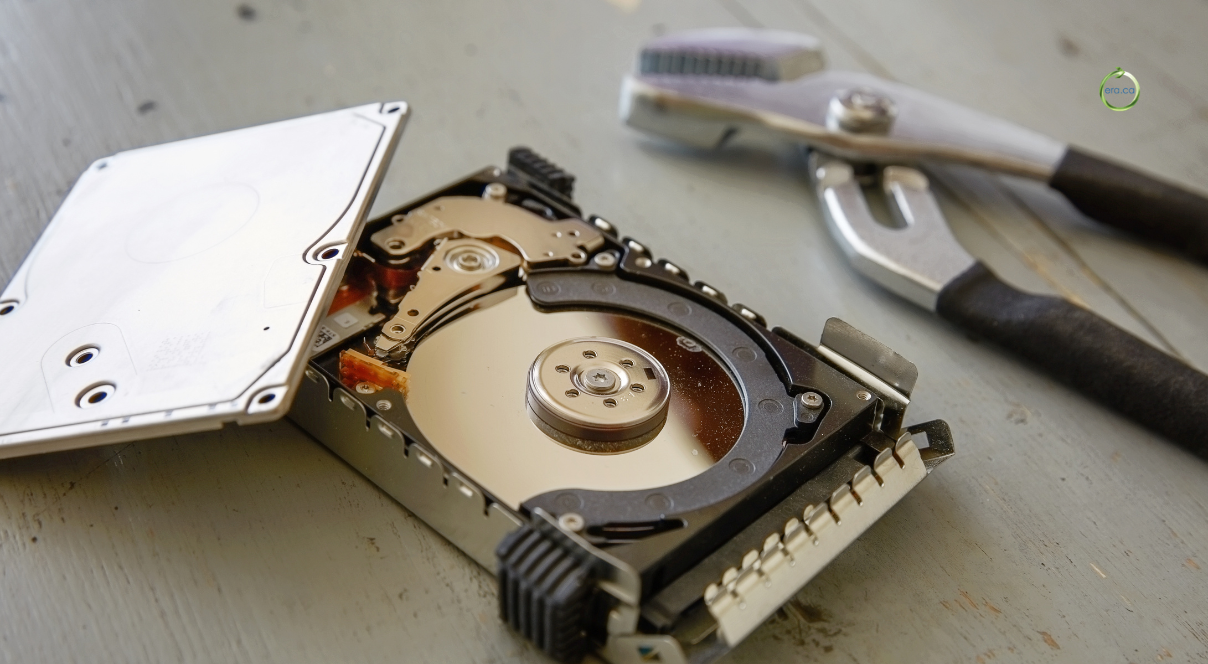
Why Deleting Files Is Not the Same as Destroying a Drive
A deleted file does not leave your hard drive. Dragging documents into the trash and emptying it only removes the marker that tells your computer where the data sits. The information itself stays on the platters until something writes over it, and recovery software that costs a few dollars can often pull it right back. For an old laptop holding client records, tax returns, or patient files, that gap between deleted and gone is exactly where data breaches begin.
That gap is why businesses and households across the country start looking for hard drive shredding near me the moment a machine reaches the end of its working life. Physical destruction takes a drive that still holds readable data and turns it into a pile of twisted metal that no forensic lab can reassemble. The catch is that not every company advertising destruction works to the same standard, and a careless provider can leave your drives sitting unsecured in a warehouse for weeks before anything actually happens to them.
This guide covers how to vet a local provider, what proof you should ask for before you hand anything over, and where to find trustworthy services in major Canadian cities. The Electronic Recycling Association (ERA) has handled secure destruction for businesses, government agencies, and private donors for more than 15 years, and the warning signs and green flags below are the same ones careful clients use to judge any vendor.
What Physical Shredding Does to a Drive and When You Need It
Shredding feeds a hard drive through industrial blades that cut it into small metal fragments, destroying the platters where every byte of data is stored. Once a drive has been through a shredder, the information on it is gone for good, beyond the reach of commercial recovery tools or specialized forensic services. ERA runs AmeriShred mobile shredders built to handle hard drives, data tapes, servers, and other storage hardware, so a single visit can clear out a mix of equipment rather than just standard desktop drives.
It helps to picture the scale of the destruction. A shredded drive is not simply bent or drilled, which can leave portions of a platter intact and readable, but broken into pieces small enough that reconstructing even a fragment of the original surface becomes impossible. That distinction matters when a provider pitches cheaper alternatives such as degaussing or punching a hole through the case, because those methods can fall short on certain modern drives while a full shred leaves nothing to work with.
Shredding is not always the right answer, though. For most machines headed toward reuse, software wiping does the job at lower cost, which is why ERA applies a multiple pass erasure process to equipment slated for refurbishment. Destruction earns its place when the data is highly sensitive, when a client contract or internal policy demands physical destruction, or when a drive is too damaged to power on for a proper wipe. A drive that will not spin up still holds its data on the platters, and software has no way to reach it, which leaves the shredder as the only reliable option. A finance firm retiring drives full of account numbers and a hospital clearing out old workstations both fall squarely into the shred category, while routine office laptops usually do not.
How to Tell a Reputable Shredding Provider From the Rest
A trustworthy provider can show you, in writing, exactly what happened to each drive. The line between a careful service and a risky one usually comes down to documentation, certification, and a verifiable chain of custody rather than whoever quotes the lowest price. When you compare options for hard drive shredding near me, look past the booking form and ask what proof of destruction lands back in your hands once the job is done.
Price still matters, but it should never be the only filter. A bargain operator with no certifications and no paper trail can cost far more than it saves if a single drive resurfaces with readable data. ERA built its data security and destruction services around proof at every step, partly because studies show that fear of data being recovered from old equipment is one of the biggest reasons people hesitate to recycle in the first place. The three markers that follow separate providers worth trusting from the ones worth avoiding.
Certifications and Accreditations Worth Checking
The certifications that carry real weight are the ISO standards covering information security and environmental handling. ERA holds four of them. ISO/IEC 27001 governs information security management, ISO 9001 covers quality, ISO 14001 addresses environmental management, and ISO 45001 deals with health and safety. Each standard means an independent auditor has reviewed the provider’s processes against an international benchmark, not that the company simply printed a logo on its website.
When you check a provider, ask whether its certificate is current and which standard it actually covers, since the four are not interchangeable. ISO/IEC 27001 is the one that speaks directly to how your data is protected while it sits in someone else’s custody, so it deserves the most attention for a shredding job. ISO 14001 tells you the shredded metal will be handled responsibly downstream instead of dumped. A provider that can name its certifications and produce the paperwork on request is showing you the same care it will apply to your drives.
Certificates of Destruction and Serial Number Tracking
A Certificate of Destruction that lists the serial number of every drive destroyed is the single most useful document a shredding provider can give you. It is your paper trail, the record that proves a specific drive was physically destroyed on a specific date rather than quietly resold or forgotten in a bin. ERA issues a Certificate of Destruction outlining the individual serial numbers of the units it destroys, and can pair it with a Collection Inventory Spreadsheet that captures the make, model, and serial number of each item collected.
For an organization subject to Canadian privacy law or regular client audits, that documentation is what demonstrates due diligence if anyone ever asks how a retired device was handled. ERA can also supply a Data Wipe Certificate for drives that were erased rather than shredded, and a Donation in Kind Certificate when equipment goes on to a charity. Keep these records on file the way you would any compliance document, since they only help you if you can produce them later, and many organizations store them alongside their asset disposal logs so the trail stays intact for years. Ask any provider whether serial-level reporting is standard or an extra cost, because a service that tracks each drive by number is far easier to defend than a vague promise that everything was taken care of.
Chain of Custody From Pickup to Shredder
Chain of custody is the unbroken record of who handled your drives from the moment they left your hands until the instant they were destroyed. Gaps in that chain are where drives quietly go missing, and a single unaccounted laptop can turn into a reportable breach. A solid provider keeps collected drives secured during transport, limits who can touch them, and gives you the option to watch the destruction happen.
ERA welcomes representatives from the originating company to observe destruction at its facilities, and can provide live or recorded video of the process on request when sending someone in person is not practical. If you would rather keep things simple, ERA’s recycling depots across Canada give you a fixed, known drop-off point instead of handing equipment to an unfamiliar courier. Either way the goal is the same, which is making sure there is never a window where your drives are sitting somewhere unwatched and unaccounted for.
On-Site Versus Off-Site Destruction and How to Decide
On-site destruction means a mobile shredder comes to your building and your drives are reduced to scrap without ever leaving the property intact. Off-site means the provider collects the drives and destroys them at its own facility. Both can be completely secure, and the right pick depends on your security policy, your volume, and your budget rather than one option being universally safer than the other.
ERA brings an AmeriShred mobile shredder directly to your facility, where its staff carry out the destruction onsite and supply a Certificate of Destruction on request. The off-site route has ERA pick up the drives and destroy them at its location, with the same certificate and the option to observe or receive video. For organizations whose protocols require sensitive material to stay on the premises at all times, ERA also rents its mobile units so one of your own people can shred the drives personally.
Volume is often the deciding factor. A household with one or two drives rarely needs a truck dispatched, so a depot drop-off or a scheduled pickup handles it cleanly. A company decommissioning a full floor of workstations benefits from on-site destruction that clears everything in an afternoon and produces a single certificate covering the whole batch. On-site work tends to suit high-security environments and large jobs, while off-site collection often makes sense for smaller volumes or tighter budgets where sending equipment out is acceptable. Knowing which camp you fall into before you call saves a round of back and forth.
Where to Find Secure Destruction Across Western Canada
Western Canada has several established options for hard drive shredding near me, with ERA running depots and pickup services across British Columbia, Alberta, Saskatchewan, and Manitoba. That regional footprint matters, because a provider with a nearby depot can offer both scheduled pickups for businesses and walk-in drop-off for households without shipping your drives halfway across the country first.
Vancouver, Calgary, and Edmonton
ERA’s British Columbia operation runs out of Richmond, serving Vancouver and the wider Lower Mainland with both drop-off and pickup. In Alberta, the organization maintains depots in Calgary and Edmonton, two cities with heavy corporate and government turnover of IT equipment. Each location handles the full range of work, from a single household laptop to a pallet of servers pulled from an office refresh.
Businesses in these centres often retire equipment in waves, clearing out dozens of machines when a lease ends or a department upgrades. ERA’s mobile shredders can come on-site for those larger jobs, while smaller donors can simply bring drives to the nearest depot. The volume of end-of-life equipment in these three cities stays steady year round, and ERA’s presence in each means you are not waiting on a provider to drive in from another province when a deadline is tight. Because ERA is a non-profit with a reuse-first approach, drives that can be safely wiped are refurbished and donated rather than destroyed, which keeps usable machines out of the shredder and in the hands of people who need them.
Saskatoon and Winnipeg
On the Prairies, ERA operates a Saskatoon depot and a Winnipeg location that together cover Saskatchewan and Manitoba. Smaller cities often have fewer certified destruction providers than the major metros, so a national non-profit with a real local presence fills a gap that would otherwise force residents to mail drives elsewhere or trust whoever happens to be closest.
For a small business in Saskatoon or a school board in Winnipeg, the practical questions are the same as anywhere else, which is whether the provider can produce a Certificate of Destruction, secure the drives in transit, and recycle the leftover material responsibly. ERA answers all three, and its pickup service means even a one-time clear-out of old equipment does not require a long drive across the city. Winter logistics are a genuine concern on the Prairies, and a provider that can schedule a pickup rather than expecting you to haul equipment across town in January is worth keeping on file. Households can drop off a single drive, and larger organizations can book a scheduled collection that fits around their operations.
Where to Find Secure Destruction Across Central and Eastern Canada
Central and Eastern Canada is ERA’s busiest territory, with depots in Toronto, Ottawa, Montreal, and Halifax handling everything from single households to corporate refresh projects involving hundreds of drives. You can check the full list of ERA locations across Canada to confirm the closest option before you book, since coverage extends into the surrounding regions of each city rather than stopping at the city limits.
Toronto and Ottawa
ERA’s Toronto depot sits in Scarborough on the east side of the city, putting secure destruction within reach of the entire Greater Toronto Area. The Ottawa operation covers the national capital region, where federal offices, contractors, and a dense cluster of technology firms generate a steady stream of retired equipment that needs careful handling.
GTA businesses tend to retire laptops and servers in bulk during lease cycles, and ERA’s on-site shredding suits those projects well, with staff destroying the drives at your office and leaving a Certificate of Destruction behind. In Ottawa, organizations handling government-adjacent work often need the serial-level reporting and witnessed destruction that ERA provides as standard. For a household clearing out an old desktop, the same depots accept individual drives without any minimum, so a single hard drive gets the same documented treatment as a corporate batch.
Montreal and Halifax
ERA’s Quebec presence runs out of Lachine, serving greater Montreal with the same pickup and drop-off options available elsewhere. On the East Coast, the Halifax-area depot in Bedford anchors ERA’s Atlantic Canada coverage, giving Nova Scotia residents and businesses a certified destruction option without shipping drives to central Canada.
Each of these cities sees the full spread of customers, from individuals retiring a personal machine to companies decommissioning a server room. Distance is the real challenge in Atlantic Canada, where shipping drives to a far-off facility adds both cost and risk, so a local Bedford depot keeps the chain of custody short. The process holds steady across all of them, which means collection, secure handling, destruction by mobile shredder or at an ERA facility, and a certificate documenting what was destroyed. Wherever you are in the region, the questions worth asking stay constant, and a provider that answers them clearly in Halifax is following the same standard one would expect in Montreal.
Questions to Ask Before You Book a Shredding Service
A handful of direct questions will tell you almost everything about a provider before you commit. Ask what documentation comes back to you, and listen for a clear answer about a Certificate of Destruction with serial numbers rather than a vague reassurance. Ask whether destruction happens on-site or off-site, and whether you can observe it. Ask which certifications the company holds and whether they are current.
Two more questions round out the picture. Ask what happens to the shredded material afterward, because a responsible provider recycles the metal rather than sending it to a landfill. Then ask about cost and turnaround, keeping in mind that price usually tracks with volume, the on-site or off-site choice, and how much reporting you need. It is fair to ask how quickly the provider can turn a job around and whether it can hold a fixed date, which matters when an office move or an audit is driving the timeline. Once the answers line up with what you expect, you can book a pickup or arrange a depot drop-off with confidence. A vendor that gets defensive about plain questions is telling you something useful before you have spent a dollar.
What Happens to Your Drive After It Is Destroyed
The best answer to hard drive shredding near me is a provider that wipes out your data and keeps the leftover material out of a landfill. After a drive is shredded, the metal fragments are sorted and routed into proper material recovery, where steel, aluminum, and the small amounts of precious metal inside get reclaimed instead of buried. Destruction and responsible recycling are two halves of the same job, and a serious provider handles both.
This is where ERA’s model stands apart from a pure shredding outfit. As a non-profit built around reuse, ERA shreds only the drives that truly need it, while equipment that can be securely wiped is refurbished and donated to charities, schools, shelters, and community groups across Canada. Over more than 15 years, that approach has put working technology into the hands of people who could not otherwise afford it. There is a practical upside too, since diverting working equipment into reuse rather than scrapping it stretches the value of every device a business retires and supports the sustainability targets many public bodies now report against. Choosing a provider like this means your sensitive data is gone for good and a still-useful machine may go on to help someone, rather than every device ending up as scrap.
Booking Trusted Destruction With ERA
Finding a service you can trust comes down to documentation, certification, and a clear chain of custody, and ERA delivers all three in cities across Canada. Whether you have one old laptop or a server room to clear, ERA offers on-site and off-site destruction, certificates that track every drive by serial number, and a reuse-first approach that keeps working technology in service. Reach out to ERA to arrange secure destruction in your city and put your retired drives beyond recovery for good.