

A retired computer can still contain personal information, so its disposal is part of privacy protection. PIPEDA applies to private-sector organizations handling personal information in commercial activities that cross provincial or national borders, as well as to federally regulated organizations. Alberta, British Columbia and Quebec generally have substantially similar provincial laws for handling that stays within the province, so the applicable rules depend in part on where information moves. Meeting PIPEDA compliance requirements for corporate IT asset disposal starts with identifying which law applies and ensuring personal information is securely destroyed or made anonymous.
A disposal provider should protect devices and data during collection, transport and destruction. Using a third party, however, does not remove an organization’s responsibility for personal information in its care. Clear contracts, appropriate safeguards and disposal records help demonstrate due diligence.
This guide explains what PIPEDA covers, how to handle information that is no longer needed, and what to document when working with a disposal provider. A practical process connects data mapping, security safeguards and disposal records to help protect privacy while managing retired IT assets responsibly.
Key Takeaways
- Map where personal information is handled and which privacy rules apply to your organization’s activities across Canada.
- Set a clear process for disposing of information that’s no longer needed, with safeguards suited to its sensitivity.
- Keep records of every personal-information breach for at least 24 months after it occurs, as required under PIPEDA according to the Office of the Privacy Commissioner of Canada.
- Build privacy clauses and disposal confirmations into service-provider arrangements, while retaining responsibility for information in your organization’s care.
What is personal information?
PIPEDA defines personal information as factual or subjective information about an identifiable individual. It may be recorded or unrecorded. A corporate laptop, for example, could contain an employee’s contact details, performance notes, customer records or saved correspondence. While the device holds that information, it remains within the organization’s privacy responsibilities.
PIPEDA applies to organizations handling personal information in commercial activities when that information crosses provincial or national borders. It also applies to federally regulated organizations, including when they handle employee information. Alberta, British Columbia and Quebec generally have substantially similar provincial laws for information handling within their borders. Cross-border activity can therefore bring PIPEDA into scope.
Start by reviewing why each type of information was collected and whether it is still needed for that purpose. PIPEDA emphasizes limiting collection, and organizations should not keep personal information longer than necessary for its identified purposes. A retired workstation, for instance, might contain old customer files alongside records still needed for a legitimate business purpose. Make retention decisions for each type of record rather than treating the entire device as one category.
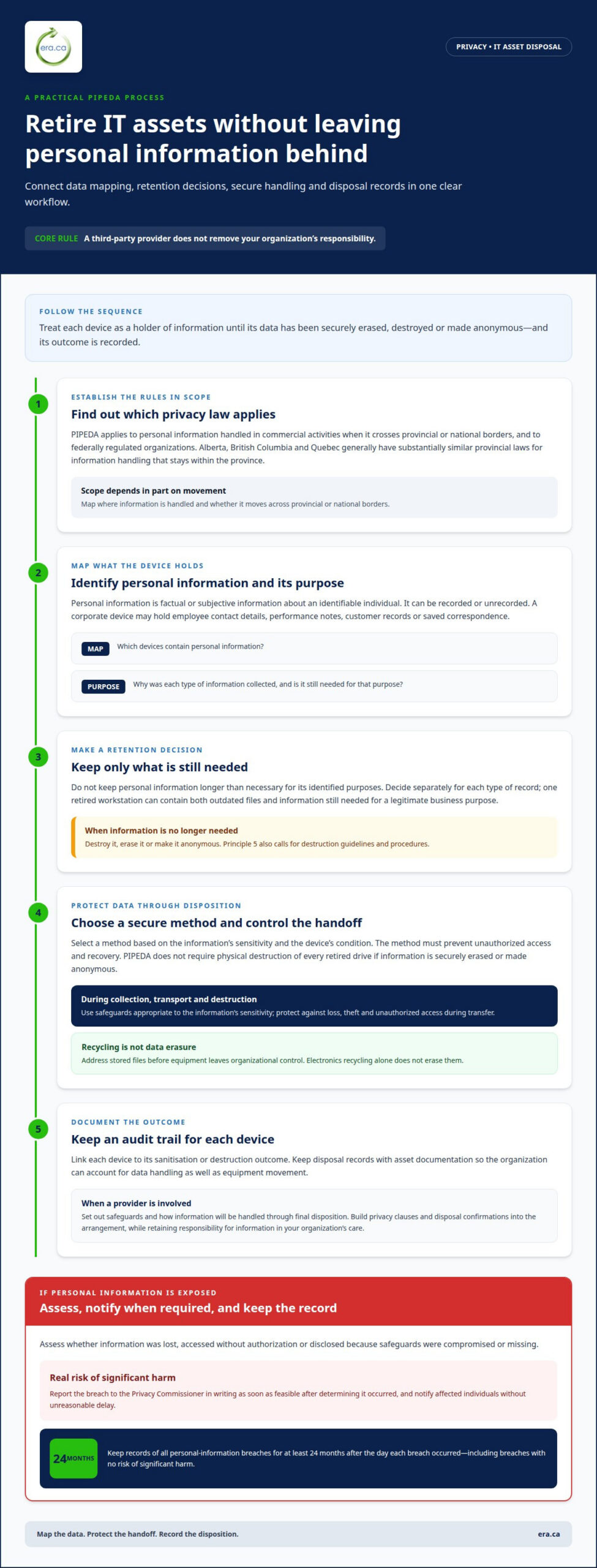
What are PIPEDA requirements for retaining, securely disposing of, or destroying personal information? Keep it only as long as needed for its identified purposes; when it’s no longer needed, destroy it, erase it, or make it anonymous. Principle 5 also calls for destruction guidelines and procedures. Paragraph 4.7.5 requires care during disposal or destruction to prevent unauthorized access. PIPEDA doesn’t require physical destruction of every retired drive if information is securely erased or made anonymous. The method should prevent recovery or access, especially where the information is sensitive.
An organization’s responsibility does not end when information leaves its premises. It remains responsible for personal information held by a third party, so disposal arrangements should set out safeguards and how information will be handled through final disposition. For corporate IT asset disposal, identify which devices contain personal information, the purpose for holding it and its retention status. Then ensure the disposal process addresses that information securely.
How is consumer data protected?
The Personal Information Protection and Electronic Documents Act governs how organizations collect, use, disclose and retain personal information. During IT disposal, protect that information through secure handling and establish a clear response in case it is exposed.
Secure Destruction and Electronics Recycling
Secure data destruction removes personal information from electronic devices, while electronics recycling directs retired equipment toward responsible recovery. Recycling by itself does not erase stored files. A laptop sent for recycling could still contain customer records or employee documents, so address the data before the device leaves organizational control. This reduces the risk of disposal becoming an avoidable privacy incident.
Sanitisation and Destruction Documentation
For electronic storage, organizations can use methods intended to make information unrecoverable or destroy the media. Choose an approach based on the information’s sensitivity and the device’s condition. A disposal record can link each device to its sanitization or destruction outcome, creating an audit trail for internal review. Keep that record with the asset documentation so the organization can account for data handling as well as equipment movement.
Breach Risk Assessment and Notification
A breach risk assessment considers whether personal information was lost, accessed without authorization, or disclosed because safeguards were compromised or missing. If the breach creates a real risk of significant harm, the organization must report it to the Privacy Commissioner in writing as soon as feasible after determining it occurred, and notify affected individuals without unreasonable delay. Organizations subject to PIPEDA must keep records of all personal-information breaches for a minimum of 24 months after the day the breach occurred, including breaches with no risk of significant harm, according to the Office of the Privacy Commissioner of Canada.
Safeguards for Erasing Device Data
PIPEDA requires safeguards appropriate to the information’s sensitivity, including protection from loss, theft, or unauthorized access during transfer. For device disposal, that means controlling access and protecting equipment while it moves between locations. The law doesn’t require physical destruction of every drive if information is securely erased or made anonymous. Choose a method that prevents unauthorized access and recovery; secure data destruction can support that disposal step.
Administrative monetary penalties and due diligence
For Canadian private-sector organizations, disposal controls can affect privacy risk and enforcement exposure. The Office of the Privacy Commissioner of Canada investigates PIPEDA complaints and can enter compliance agreements. Binding orders and damages are determined by the Federal Court on application. Documented decisions, assigned responsibilities and consistent disposal practices help show that privacy protection is built into operations.
Bill C-27 proposed the Consumer Privacy Protection Act (CPPA) as a replacement for PIPEDA. Under proposed section 94(3), an administrative monetary penalty could not be imposed if an organization established that it exercised due diligence to prevent the contravention. This is a proposed provision, not a PIPEDA rule. For IT disposal, useful due-diligence evidence could include defined procedures, staff responsibilities, vendor contract terms, and records showing that those practices were followed.
How do provincial privacy laws in Alberta, British Columbia and Quebec affect corporate IT asset disposal? Their private-sector privacy laws generally cover personal-information handling that stays within the province, while PIPEDA generally covers interprovincial or international commercial activity and federally regulated organizations. If devices or information cross provincial borders during disposal, account for PIPEDA alongside applicable provincial requirements. Map where information is held and handled to identify the rules governing the process.
Quebec’s Law 25 adds distinct financial exposure for organizations subject to its requirements. Administrative monetary penalties can reach the greater of C$10 million or 2% of worldwide turnover. Penal fines can reach the greater of C$25 million or 4%. These are separate penalty categories, so a company’s disposal controls should be considered within its wider privacy practices, not as an isolated equipment task. In Quebec, documented safeguards, clear responsibility for service providers, and evidence of appropriate disposal decisions support accountable handling of personal information.
Service-provider data mapping and disposal confirmations
A disposal map tracks devices and personal information from collection through final disposition. Record asset identifiers, information types, transfer points, responsible organizations and each provider’s role. For example, a laptop may move from an office to a transport team and then to a destruction site. Mapping these stages can reveal gaps, such as an undocumented handoff or unclear responsibility. The PIPEDA compliance requirements for corporate IT asset disposal are easier to demonstrate when each transfer has an accountable owner.
Contracts should define the provider’s privacy safeguards, access controls, destruction process and breach-notification responsibilities. They should also cover recordkeeping and allow monitoring or audits for quality control. These terms matter in every sector and province because an organization remains responsible for personal information held by a third party. Consent to collect information does not remove that responsibility when a device later leaves the organization’s custody.
Connect the disposal map to supporting evidence. A record can identify the device, transfer date, recipient, method used and completion status. This creates a traceable account if an internal review or inquiry from the Privacy Commissioner of Canada requires the organization to explain how it handled the information. Record how exceptions were resolved too, such as a device delayed in transit or returned before destruction.
Under proposed CPPA section 55(3), an organization receiving a disposal request would have to inform service providers and obtain confirmation that the information was disposed of. Though proposed, this provision highlights the value of a closed-loop process: communicate the disposal requirement, track the provider’s work, and retain confirmation. In practice, the PIPEDA compliance requirements for corporate IT asset disposal call for connecting that confirmation to the mapped asset and its intended disposition.
For corporate equipment containing personal information, arrange secure data destruction as part of a documented disposal process. A clear map and completion record connect privacy safeguards with responsible electronics handling.
Electronic Recycling Association (ERA)
The Electronic Recycling Association (ERA) helps organizations manage retired IT equipment through free electronics recycling, secure data destruction, pickup and charitable computer donations. These services can support a disposal plan that separates data protection from equipment recovery: securely address personal information, then direct suitable devices toward recycling or donation. This can help when replacing business computers, clearing storage equipment or organizing retired electronics. Organizations remain responsible for personal information in their custody, so include disposal steps in privacy controls and records. Contact ERA to discuss your corporate IT asset disposal needs.
Make privacy part of every equipment decision
Include disposal in the same planning cycle as purchasing and equipment replacement. Assign responsibility for privacy decisions before devices are retired, so data handling is not left until the last minute. Connect the asset register to retention decisions and the records used to close each disposal request. This makes handoffs between privacy, IT, procurement and operations clearer.
Applying PIPEDA compliance requirements for corporate IT asset disposal is an ongoing responsibility, not a one-time policy update. Review the process when equipment, service arrangements or information flows change, and keep procedures aligned with how devices are actually handled. A consistent approach can protect personal information while supporting responsible equipment reuse and recovery.
For support with a corporate electronics disposal plan, contact Electronic Recycling Association (ERA). Take the next step with a process that serves both privacy and the wider community.
Frequently Asked Questions
Does PIPEDA apply throughout Canada?
Yes. PIPEDA can apply in every province and territory, particularly when commercial handling of personal information crosses provincial or national borders. It also applies to federally regulated organizations. Alberta, British Columbia and Quebec generally have substantially similar provincial privacy laws for information handling within their borders, so consider both the organization’s activities and where the information is handled.
What does PIPEDA require when disposing of IT assets containing personal information?
Organizations must protect personal information during disposal and ensure information no longer needed for its identified purposes is destroyed, erased or made anonymous. Before retiring a laptop, for example, determine whether its drive contains records still required for a business purpose. Then use a method that prevents unauthorized access or recovery, and record the device’s final disposition as part of the privacy process.
Which Canadian organizations and activities are subject to PIPEDA during asset disposal?
PIPEDA applies to private-sector organizations handling personal information in commercial activities when that information moves between provinces or across national borders. It also covers federally regulated organizations, including their handling of employee information. This can affect a company whose retired devices travel to a disposal facility in another province. Map those transfers and identify whether provincial privacy laws also apply to activity within a province.
How should organizations document and verify data sanitization or destruction of IT assets?
Maintain an asset-level record that links each device to its sanitization or destruction outcome. Include an asset identifier, handling date, method used and completion confirmation. For example, an inventory entry can point to a provider’s destruction record, making a particular drive easier to trace during an internal review. Keep the record with disposal documentation and note exceptions, such as an item returned before processing.
What should a corporate IT asset disposal chain of custody and vendor contract include under PIPEDA?
Document every custody handoff, including the asset identifier, transfer, recipient and disposition status. Contract terms should describe security safeguards, access controls, destruction procedures and how the provider will notify the organization of a breach. They can also set expectations for records, monitoring and audits. These details help the organization oversee information handled by a service provider rather than treating collection as the end of its responsibility.
What are the breach reporting and notification requirements if personal information is exposed during IT asset disposal?
If a breach creates a real risk of significant harm, the organization must report it to the Privacy Commissioner in writing as soon as feasible after determining it occurred, and notify affected individuals without unreasonable delay. The Office of the Privacy Commissioner of Canada says breach records must be kept for at least 24 months after the breach, including incidents without significant-harm risk. Record the facts, assessment, and response.