

Why the On Site or Off Site Decision Deserves Real Attention
A stack of retired laptops sitting in a storage room is a liability, not clutter. Every one of those drives can still hold client records, payroll files, and login credentials long after the device stops booting. For a Canadian business, the question is rarely whether to wipe or shred those drives. It is where that work should happen. Do you bring a shredder to your loading dock and watch each drive turn to fragments, or do you hand the equipment to a processor who takes it away and sends back a certificate?
Both paths reach the same outcome, which is data that cannot be recovered. What differs is the oversight you keep, the cost per device, and the paperwork you can show an auditor. On-site work gives you eyes on every drive until it is destroyed. Off-site work trades some of that direct observation for lower cost and less disruption to your day.
The Electronic Recycling Association handles both for organizations across the country, pairing certified data destruction services with a reuse mission that keeps working equipment out of landfills. Getting the on-site versus off-site call right means matching the method to your data sensitivity, your volume, and the privacy rules you answer to. Choosing secure destruction that fits your risk profile starts with understanding what each option really puts in front of you.
What On Site Hard Drive Destruction Looks Like in Practice
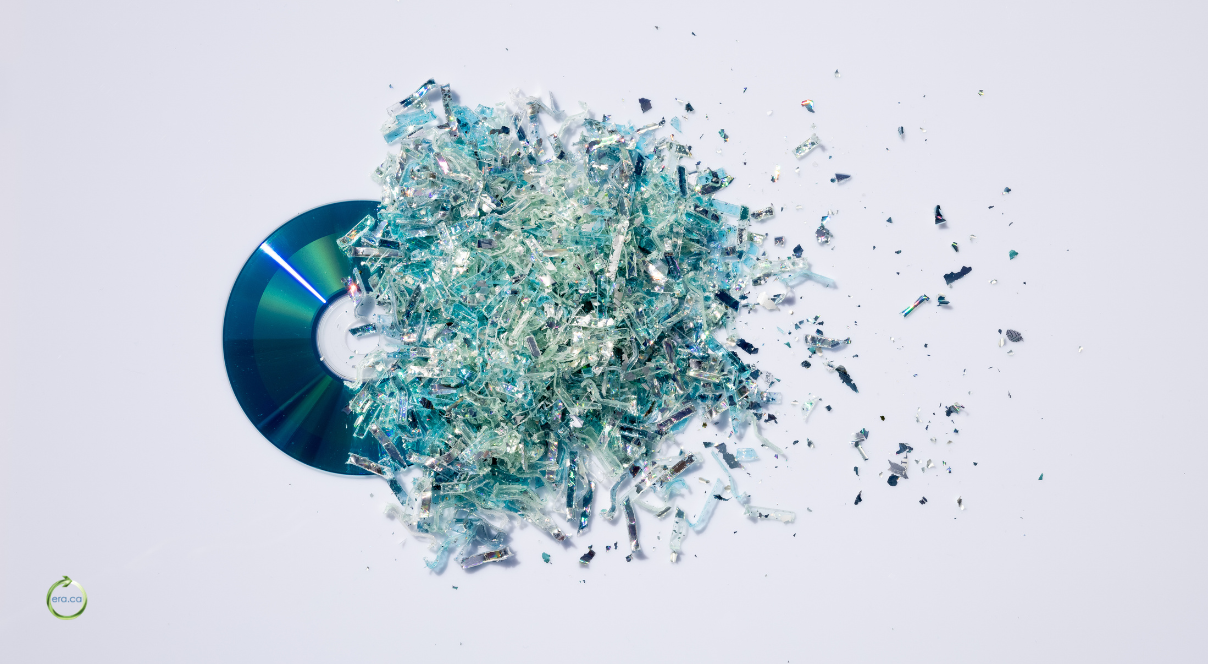
On-site destruction means the equipment never leaves your control until it is already destroyed. ERA sends an AmeriShred mobile shredder to your location, and your team watches drives feed into the machine one after another. The output is a bin of mangled metal and platter fragments, not a working storage device. Chain of custody starts and ends inside your own building, which removes the window of risk that opens whenever hardware travels.
The appeal is straightforward. A hospital IT director or a bank branch manager can stand next to the shredder and confirm with their own eyes that serial number 4471 is now scrap. There is no truck ride, no overnight holding at a facility, no trust required beyond the machine running in your parking lot. For drives that held medical histories or financial account numbers, that direct line of sight can matter as much as the shredding itself.
There is a practical version of this too. ERA also rents AmeriShred units to organizations whose internal protocols require material to stay on premises and be handled by their own staff. Your people run the shredder, your people bag the debris, and nothing sensitive passes through outside hands. That setup suits security policies that treat physical possession as non-negotiable, and it keeps the entire process under one roof.
Which Organizations Lean Toward On Site Shredding
Regulated industries pick on-site shredding most often. Healthcare providers holding patient files, financial firms sitting on account data, and law offices with privileged client records all operate under rules that reward direct observation. When a compliance officer has to sign off that data was destroyed, being physically present for the shredding turns an assumption into a documented fact.
Volume pushes the decision too. A company clearing out a data center during a hardware refresh might have three hundred drives to retire in a single week. Handling that on-site means one scheduled visit, one witnessed session, and one clean certificate covering the whole batch. Government departments and municipal fleets bound by procurement rules often land here as well, since bid requirements sometimes specify that destruction happen under the client’s supervision.
Cost tolerance shapes it from the other side. On-site service carries a premium because a shredder and an operator come to you. Organizations that choose it have usually decided the added oversight is worth paying for, either because their data warrants it or because an auditor expects it. For a small office retiring a handful of old machines, that math rarely works, which is where the off-site route starts to make more sense.
How Off Site Destruction Works From Pickup to Certificate
Off-site destruction starts with a pickup. You schedule an equipment pickup, ERA dispatches a truck sized to the job, and your retired devices are loaded and logged before they leave. From there the equipment travels to an ERA facility, where drives are either wiped with erasure software or physically shredded depending on the service you requested. Working machines that can be safely repurposed get refurbished. Anything holding data gets cleared first, without exception.
What you give up in direct line of sight, you gain back in cost and convenience. There is no shredder to schedule into your building, no operator standing in your lot, and no premium for a mobile unit. For most volumes, off-site is the cheaper and simpler path, which is why it suits offices retiring dozens of devices rather than hundreds.
The oversight gap is smaller than it sounds. ERA welcomes company representatives to observe destruction in person at the facility, and for teams that cannot travel, live or recorded video of the process is available on request. You do not have to take anything on faith. The chain of custody is documented from the moment the truck is loaded through to the certificate that lists each drive by serial number, so the paper trail stays intact even though the work happens off your property.
Keeping Chain of Custody Intact When Drives Leave the Building
Chain of custody is the record that proves nobody could have quietly pocketed a drive between your office and the shredder. Off-site, that record begins at pickup, when ERA logs the equipment being collected and issues a Collection Certificate along with a Collection Inventory Spreadsheet that captures make, model, and serial number for each device. From that point forward, every drive is accounted for on paper.
The tracking follows the hardware through processing. When a drive is wiped, you can receive a Data Wipe Certificate. When it is physically destroyed, a Certificate of Destruction lists the individual serial numbers that went through the shredder. If a serial number appears on the collection inventory but not on the destruction certificate, you would know immediately, which is exactly the kind of gap an auditor looks for.
The documentation is granular enough that you can reconcile what left your building against what was destroyed, device by device. For a business that has to demonstrate compliance months later, that reconciliation is often more useful than a memory of watching a shredder run. The paper follows the drive, and the paper is what you keep.
Weighing Cost and Volume Between the Two Options
Cost usually decides this for organizations without a strict oversight mandate. Off-site destruction is the more affordable option because ERA processes drives at its own facilities using equipment that is already in place. On-site service carries a premium since a mobile shredder and a trained operator have to travel to you and dedicate time to your batch alone. For a business retiring twenty laptops, that premium rarely pays for itself.
Volume changes the calculation. Once you are destroying hundreds of drives in one purge, the per-device economics of an on-site visit improve, and the value of witnessing a single large session goes up alongside them. A data center decommission or an office relocation that clears out years of accumulated hardware can justify the on-site premium on volume alone.
The reporting you need also affects the bill. Serial number tracking, detailed inventory spreadsheets, and formal certificates add labor, and requesting them for every device costs more than a simple bulk wipe. None of this makes secure destruction expensive by default. It means the price scales with how much control and documentation you require. A small nonprofit clearing a closet of old desktops and a hospital retiring an imaging server are buying very different levels of assurance, and the cost reflects that.
The Paperwork That Proves Your Data Is Gone
A Certificate of Destruction is what separates real compliance from a good-faith assumption. Without it, you have a story about drives being destroyed. With it, you have a signed record listing individual serial numbers, dated and tied to your organization. If a regulator or a client ever asks how you disposed of a device that held their data, that certificate is the answer.
ERA issues documentation matched to the service performed. A Collection Certificate confirms what was picked up. A Collection Inventory Spreadsheet records make, model, and serial number for each unit. A Data Wipe Certificate covers drives cleared by software, and a Certificate of Destruction covers drives that were physically shredded. Organizations that donate equipment can also receive a Donation in Kind Certificate for their records. Together these documents let you trace any single device from the moment it left your hands.
Keep these certificates the way you keep tax records. Privacy investigations and client audits can arrive years after a device was retired, and the burden falls on you to show the data was handled properly. A drive you shredded in 2023 is only defensible in 2027 if the paperwork still exists. The proof outlives the device, and the proof is what protects you.
How Canadian Privacy Rules Shape the Choice
Canadian privacy law expects personal information to be destroyed securely once a business no longer needs it, though it stops short of dictating whether that happens on-site or off. The federal Personal Information Protection and Electronic Documents Act, known as PIPEDA, requires organizations to protect personal data through its entire life, and disposal is part of that life. Several provinces, including Alberta, British Columbia, and Quebec, run their own private-sector privacy laws that apply instead of or alongside the federal rules.
What the law does not do is hand you a specific shredding method or a required particle size. That flexibility is why the on-site versus off-site decision sits with you rather than a statute. Regulators care about the outcome, which is data that cannot be reconstructed, and about your ability to prove you got there. This is where documentation and certified processes carry real weight, since they turn a legal obligation into demonstrable action.
None of this is legal advice, and the exact requirements that apply to your organization depend on your province, your industry, and the type of data you hold. A law firm or a healthcare provider should confirm its obligations with counsel. What holds across the board is that reliable secure destruction, backed by paperwork, is far easier to defend than an informal wipe with no record behind it.
Physical Shredding Compared With Software Wiping
These are two different answers to the same problem, and the right one depends on whether the drive has a future. Software wiping overwrites every sector of a drive with random data, often in multiple passes, until the original files cannot be recovered. The drive still works afterward, which means it can be refurbished, donated, or resold. Shredding takes the opposite approach and physically reduces the drive to fragments, ending its life entirely.
ERA uses both. For equipment that is healthy enough to serve a second owner, wiping with erasure software clears the data while preserving the hardware, which fits the organization’s focus on reuse. For drives that are failing, obsolete, or simply too sensitive to let out of the building intact, the AmeriShred shredders handle the physical side. The two methods are not competing so much as covering different situations.
The decision often tracks data sensitivity more than device condition. A working laptop from an accounting firm might be perfectly reusable, yet the firm may still insist on shredding because the data it held was too sensitive to risk. A wiped drive is statistically unrecoverable, but a shredded drive is physically gone, and some compliance regimes prefer the certainty of gone.
When Software Erasure Does the Job
Software erasure is the right call when the hardware still has life left in it. A three-year-old office laptop that was swapped out during a refresh is usually far from dead. Wiping it with certified erasure software removes every trace of the previous user’s data while keeping the machine intact, so it can go to a charity, a school, or a family that needs it. Destroying that laptop instead would waste a working computer.
The security holds up for most business scenarios. Modern wiping tools overwrite drives in ways that make recovery unrealistic even with specialized equipment, and a Data Wipe Certificate documents that the work was done. For general office data, standard business records, and equipment headed for reuse, this level of assurance meets the need without turning usable hardware into scrap.
This approach also carries ERA’s environmental mission forward. Every drive wiped instead of shredded is a device that can be refurbished and donated to charities rather than recycled for raw materials. When the data allows it, wiping serves both the compliance goal and the goal of keeping technology in use longer.
When Physical Shredding Is the Safer Bet
Shredding wins whenever certainty matters more than salvage. Some data is sensitive enough that no amount of overwriting feels sufficient to the people accountable for it. Government records, health data, financial account details, and legal files often fall into this category, where the standard is not merely unrecoverable but physically nonexistent. A shredded platter cannot be read by anyone, ever, and for certain regimes that finality is the requirement rather than a preference.
Failed drives make the case on their own. A dead drive cannot be wiped, because wiping needs a functioning device to run the overwrite. If the drive will not power on, software is off the table, and shredding becomes the only reliable way to guarantee the data is gone. Trying to wipe a failing drive can leave sectors untouched, which is precisely the risk you are trying to eliminate.
There is also the matter of policy. Some organizations simply mandate destruction for any drive that touched regulated data, regardless of whether it still works. In those cases the drive’s condition is beside the point, and the shredder is the answer the policy requires.
Matching the Approach to Your Industry
Different sectors carry different defaults, shaped by the data they hold. Healthcare organizations deal with patient records that stay sensitive indefinitely, so many lean toward witnessed on-site shredding for anything that touched clinical systems. Financial institutions apply similar logic to account data and transaction histories, where a single exposed drive can trigger a reportable breach. For these organizations, the on-site premium is a cost of doing business rather than a splurge.
Government and legal work often add procurement and privilege into the mix. A municipal department may face bid rules that specify supervised destruction, while a law firm handling privileged files may treat direct observation as part of its duty to clients. In both cases the method is chosen to satisfy an external obligation, not just internal comfort.
General offices, retailers, and nonprofits usually sit at the other end. Their data matters and still deserves proper handling, but the sensitivity rarely demands a shredder in the parking lot. For these organizations, off-site processing with wiping and full documentation delivers dependable secure destruction at a price that fits a normal operating budget. The pattern is not a rule so much as a starting point, and plenty of organizations mix approaches across their hardware.
What ISO Certifications Tell You About a Destruction Partner
A certification is an outside auditor’s signature confirming a provider actually does what it claims. Anyone can say they destroy data securely. An ISO certification means an independent body examined the processes and found them sound, then returned to check again. For a business trusting a third party with drives full of regulated data, that external verification is the difference between a promise and a proven practice.
ERA holds ISO certifications spanning quality management, environmental management, and information security, the last of which governs how an organization protects the data in its care. The quality standard, ISO 9001, addresses consistency in how work gets done. The environmental standard, ISO 14001, covers responsible handling of materials, which matters for a recycler diverting hardware from landfills. Information security certification speaks directly to the concern at the center of any destruction job, which is keeping sensitive data protected from collection through to final processing. You can review these credentials on ERA’s partnerships and accreditations page.
The value shows up when something goes wrong. A certified provider has documented procedures, audited controls, and a track record an auditor can inspect. If your own compliance is ever questioned, working with a certified partner gives you a defensible answer about who handled your data and how. Certifications are not decoration. They are the evidence that a provider’s process would survive scrutiny.
Where Secure Reuse and Sustainability Come Into Play
The greenest drive is the one that gets a second life instead of a trip through a shredder. This is where ERA’s model differs from a pure destruction vendor. As a non-profit built around recovery and refurbishment, ERA’s first instinct is to wipe and reuse wherever the data sensitivity allows it. A cleared laptop that goes to a classroom keeps a working machine out of the recycling stream and puts it in the hands of someone who needs it.
That mission shapes the destruction choice in a specific way. Every drive that can be safely wiped rather than shredded is a device kept in service, and over the years ERA has repurposed hundreds of tons of equipment this way. Charities, schools, and community groups across Canada receive refurbished computers funded by exactly this cycle, which means responsible data handling and social benefit run on the same track.
Shredding still has its place for drives too sensitive or too broken to reuse, and nothing about the reuse goal weakens the data protection behind it. The point is that destroying a drive should be the last resort, not the default. When the data allows wiping, choosing it protects the information and the planet at once, and it turns a compliance task into something that gives back.
Making the Right Call for Your Organization
The right choice comes down to three questions. How sensitive is your data, how many drives are you retiring, and what does your compliance regime expect you to prove? Answer those honestly and the on-site or off-site decision usually makes itself. The Electronic Recycling Association handles both across Canada, with certified processes, full documentation, and a reuse mission that keeps working technology in service. Reach out to the ERA team to talk through your equipment and find the approach that fits your risk, your volume, and your budget.