


A retired computer isn’t automatically waste, and it isn’t automatically ready for donation. For Canadian organizations, electronics recycling for organizations starts with deciding what can be reused, what needs secure data destruction, and what should be recycled. Getting those decisions right can protect sensitive information while giving usable equipment a chance to support a community need.
It’s understandable to be concerned about data security and the work involved in coordinating departments, collecting devices, and keeping clear records. A practical plan can make each step more manageable. The Electronic Recycling Association is a Canadian non-profit that brings electronics recycling, secure data destruction, collection, depot drop-off, and charitable computer donations together, helping organizations address device retirement and community benefit through one end-of-life programme.
This guide explains how to sort retired equipment into appropriate next steps, build data protection into the process, and organize collection or drop-off with useful records. You’ll also learn how reuse, charitable donation, and recycling can work alongside one another, so your organization can handle its electronics responsibly without adding unnecessary complexity.
Key Takeaways
- Build an electronics recycling for organizations plan around clear decisions about reuse, data protection, and responsible recycling.
- Use a simple triage to identify equipment with a potential next purpose and separate data-bearing devices for appropriate handling.
- Compare collection and depot drop-off based on equipment volume, site access, and the effort your team can manage.
- Assign responsibilities across IT, facilities, procurement, and sustainability to keep inventories, decisions, and logistics coordinated.
- See how recycling and secure data destruction can work alongside charitable donations to support both responsible handling and community benefit.
Why electronics recycling for organizations needs a clear process
Organizational electronics recycling is a managed process for assessing retired workplace equipment, protecting information, and directing each asset to reuse or recycling; household drop-off is generally a personal, device-by-device route rather than a coordinated workplace programme. Organizations often retire equipment across departments and at different times, so a clear process helps ensure devices aren’t misplaced, overlooked, or treated as if they all need the same outcome.
Responsible retirement involves more than moving equipment out of a storage room. A device may contain organizational information, remain useful to someone else, or require recycling rather than further use. These decisions connect data stewardship with environmental responsibility and potential community benefit. For background on the materials and recovery processes involved, see this overview of electronic waste streams and hazards.
Recycling is not the only route. Equipment that is suitable for reuse may be considered for charitable donation, while devices that aren’t appropriate for a second life can follow a recycling route. Separating these outcomes helps an organization make deliberate choices rather than sending every retired asset directly into one general collection.
Which organizational priorities should the programme balance?
A sound programme balances information protection, responsible equipment handling, and the opportunity to benefit others. Data-bearing assets need appropriate controls as they leave organizational custody, but the right handling can vary by asset and data considerations. Assign an owner to coordinate decisions, while clarifying how IT, facilities, procurement, and sustainability contribute. This reduces duplicated work and makes community donation a considered option for suitable equipment.
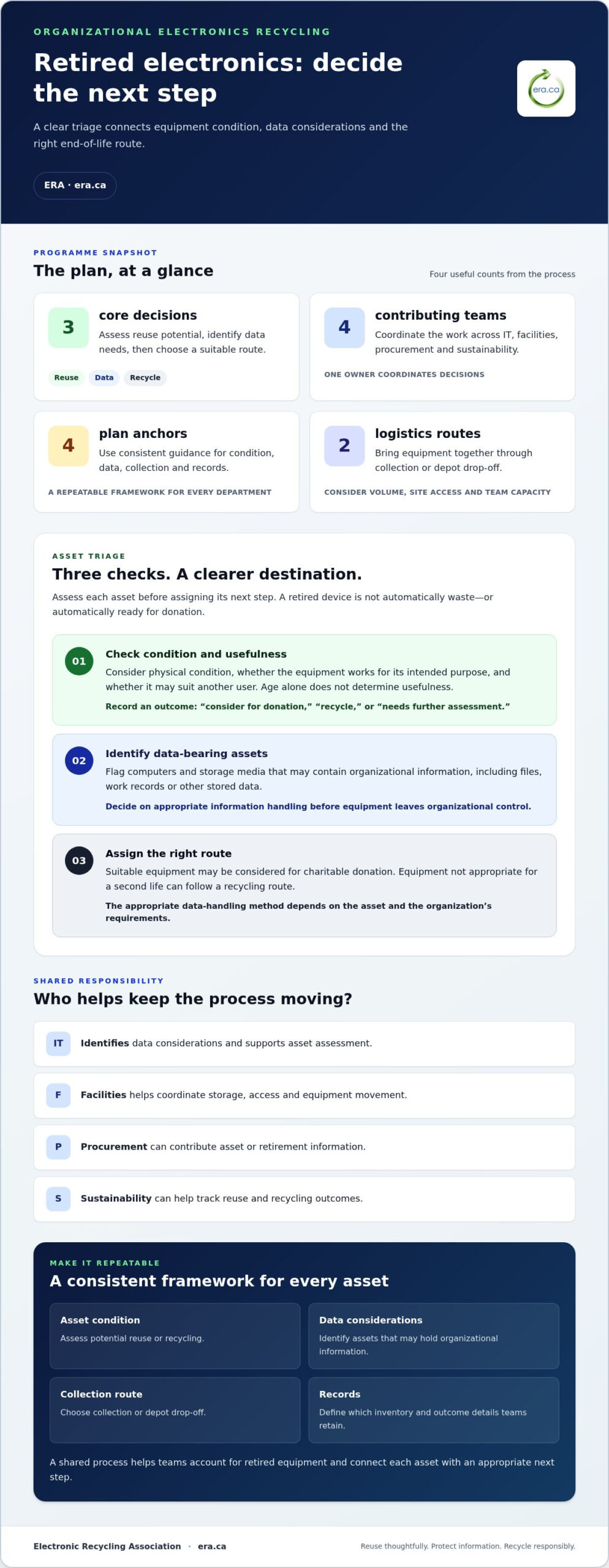
- IT identifies data considerations and supports asset assessment.
- Facilities helps coordinate storage, access, and movement.
- Procurement can contribute asset or retirement information.
- Sustainability can help track reuse and recycling outcomes.
What belongs in an organization’s end-of-life electronics plan?
Set a consistent framework before individual devices are prepared for retirement. The plan should guide teams through the same core decisions, even when equipment, locations, or departments differ. This is programme design, not a device-preparation checklist; detailed steps for preparing equipment can sit in a separate guide.
- Asset condition: assess whether equipment may be suitable for reuse or should be recycled.
- Data considerations: identify which assets may hold organizational information and require appropriate controls.
- Collection route: decide how equipment will be brought together for collection or depot drop-off.
- Records: define what inventory and outcome details teams should retain.
Apply these decisions across departments instead of relying on ad hoc disposal. A shared process gives staff a clear path to follow, helps the organization account for retired equipment, and connects each asset with an appropriate next step. That foundation makes electronics recycling for organizations easier to coordinate and repeat.
Sort organizational electronics by reuse, data needs, and recycling route
Assess each asset before assigning it a destination. A basic triage starts with condition and potential usefulness, then considers whether the device holds organizational information and what handling it needs. This sequence helps keep a functioning computer from being treated as scrap by default, while ensuring data-bearing equipment isn’t passed on or moved before the organization has decided how to protect its information.
Let asset condition and data requirements determine whether equipment is reused, securely handled, or sent for recycling.
How should an organization decide whether equipment can be reused?
Look at the device’s physical condition, whether it functions for its intended purpose, and whether it could be suitable for another user. A working computer may be a candidate for charitable donation, extending its useful life and putting equipment to a community purpose. That’s an option, not an assumption: some assets won’t be appropriate for reuse and should instead be directed to recycling.
Keep the assessment practical. Record a clear outcome for each asset, such as “consider for donation” or “recycle,” and note when its condition needs further assessment. Avoid treating age alone as a complete measure of usefulness. Equally, don’t promise a second life for equipment that’s damaged, incomplete, or unsuitable for another user.
How should data-bearing devices be considered?
Identify computers and storage media that may contain organizational information, including files, work records, or other stored data. Plan the information-handling decision before equipment leaves organizational control. The appropriate route depends on the asset and the organization’s data requirements; one handling method won’t necessarily suit every device.
The World Health Organization’s e-waste guidance provides broader context on environmental and health concerns associated with electronic waste. For an organization, that reinforces the value of considering data protection and responsible material handling together, rather than treating device retirement as a simple clear-out.
ERA offers secure data removal and on-site hard-drive destruction as part of organizational end-of-life planning. To keep this stage at the decision level, first identify which assets may hold data and establish the controls they need; detailed device-preparation steps belong in a separate secure-data guide.
A useful working triage is to group assets by their next decision, not just by department or device type:
- Potential reuse: assess condition, functionality, and suitability for another user, including charitable donation where appropriate.
- Data-bearing: identify the information-handling requirements and decide on suitable controls before transfer.
- Recycling: route equipment that isn’t suitable for reuse through responsible electronics recycling.
Keep the outcome attached to the asset record so staff can understand why it was assigned that route. This gives IT and other teams a shared basis for decisions and helps make electronics recycling for organizations consistent across departments. ERA’s secure data destruction and electronics recycling can support a programme that brings those decisions together.
Compare organization-wide recycling routes and programme requirements
Collection and depot drop-off can both support an organizational electronics programme, but they place different demands on staff. The practical choice depends on the volume of equipment, site access, and how the organization needs to manage devices and data before they leave its control. Compare the routes against your actual workflow rather than assuming one will suit every department or retirement project.
| Planning factor | Collection | Depot drop-off |
|---|---|---|
| Coordination | Coordinate equipment from relevant departments, prepare an accessible staging area, and plan access for collection. | Assign responsibility for gathering equipment and arranging its transport to a depot. |
| Internal effort | Staff organize assets and access for handover; the movement from site is arranged as a collection. | Staff organize assets and take on the transport and delivery steps. |
| May suit | Organizations managing equipment across teams or with a volume that makes a coordinated collection practical. | Organizations able to transport equipment appropriately and manage a depot handover. |
When does collection suit an organization?
Collection can be a useful route when several departments are retiring equipment and a single coordinated handover would simplify internal movement. Practical planning depends on the equipment volume, site access, and readiness of the assets. Agree on who will assemble the equipment, manage access, and keep the inventory aligned with what is handed over. Detailed device-preparation steps belong in a dedicated pickup guide.
When is depot drop-off a practical route?
Depot drop-off may suit an organization that can gather and transport its equipment appropriately. Factor in who will handle the transport, how the organization will maintain its asset records, and whether a depot route fits its data-handling plan. The equipment accepted and the operating arrangements form part of route selection, so avoid assuming every device or circumstance fits the same process.
Before choosing either route, define the programme’s scope. Specify which equipment is included, how data-bearing assets will be handled, who retains the inventory, and what records the organization needs after handover. This helps ensure that the route supports the organization’s handling requirements rather than becoming a logistics decision made in isolation. ERA offers electronics collection, depot drop-off, and secure data destruction, bringing these elements into an organizational end-of-life programme.
Also consider whether the equipment is being directed to reuse or recycling. A route should work with those asset decisions and the organization’s data controls, not replace them. For example, a department consolidating retired devices may benefit from a coordinated collection, while a smaller group of equipment may be manageable through drop-off if transport and records are handled internally. Neither route is automatically the right fit, and collection arrangements shouldn’t be assumed to be free or available on a fixed timeline.
For electronics recycling for organizations, a useful comparison comes down to three questions: how much equipment is involved, how can it be moved responsibly, and what information or records must stay under organizational control? Answering these first makes collection or drop-off easier to plan and keeps the route aligned with the purpose of the programme.
Create a repeatable electronics recycling workflow for your organization
Turn asset decisions into a consistent process staff can follow each time equipment is retired. A shared workflow helps departments know who approves decisions, how equipment is tracked, and what happens before assets leave organizational control. Keep the steps simple enough to repeat, with room for different data requirements and equipment outcomes.
Assign an owner, inventory equipment, triage each asset, set data controls, then choose and document the appropriate route.
- Assign a programme lead. Name one person to coordinate the process, communicate responsibilities, and bring unresolved decisions to the right teams.
- Inventory the equipment. Record enough identifying information to track each asset through assessment and handover, following your organization’s recordkeeping policy.
- Triage assets. Note condition and potential suitability for reuse, donation, or recycling. Record the decision and its rationale so another department can understand the outcome.
- Set data controls. Have IT identify data-bearing equipment and determine the handling requirements before it moves from organizational control.
- Choose a route and close the loop. Coordinate collection or depot drop-off, record transfers, and retain relevant completion evidence in line with internal policy.
Who should own each step of the process?
The programme lead coordinates the overall workflow, but responsibilities should be shared clearly. IT identifies data-bearing assets and internal handling requirements; facilities or operations coordinates access, staging, and movement. Procurement can provide asset information, while sustainability can help track reuse and recycling outcomes. Assign a decision owner for each step so teams contribute without creating duplicate inventories or approvals.
What records help make the programme accountable?
Maintain a record that connects each asset or group of assets to its category, decision route, responsible team, and transfer status. Add relevant service records or completion evidence as it becomes available, then retain those records according to organizational policy. Keep the main programme record distinct from a device-level preparation checklist, which can guide readiness steps without replacing accountability for the overall process.
Review the workflow after a retirement cycle. Note where handoffs were unclear, records were incomplete, or access planning caused avoidable effort, then adjust responsibilities or instructions. A consistent approach makes electronics recycling for organizations easier to manage across departments while supporting appropriate information handling and responsible equipment outcomes.
Put your workflow into practice with ERA’s electronics collection and secure data destruction as part of your organization’s retirement process.
Choose ERA for a responsible organizational electronics recycling partner
Organizational electronics retirement brings together decisions about information, equipment, logistics, and community impact. The Electronic Recycling Association (ERA), a Canadian non-profit serving organizations across Canada, offers electronics recycling, secure data destruction, equipment collection, and depot drop-off. Bringing these options into one end-of-life programme can help organizations coordinate device handling while considering whether suitable computers may have a second life through charitable donation.
ERA states that it is certified to ISO/IEC 27001, ISO 9001, ISO 14001, and ISO 45001. In plain language, these standards relate to information security, quality management, environmental management, and occupational health and safety. Together, they describe management systems in areas relevant to responsible organizational operations. Certification details and scope should be represented using ERA’s current certification wording.
How does ERA connect responsible handling with community benefit?
Some retired computers may be suitable for charitable donation, while other equipment is better directed to recycling. ERA’s charitable computer donation programme supports charities and philanthropic organizations across Canada, helping appropriate equipment serve organizations that need technology. Donation and recycling are complementary outcomes, not competing goals: assess each asset on its condition and information-handling needs, then choose a suitable route. Not every device will be appropriate for reuse or donation.
That distinction matters for organizations aiming to make retirement decisions that are both practical and community-minded. A reuse opportunity can extend a suitable computer’s service to another organization; recycling remains an important route for equipment that isn’t appropriate for donation. ERA’s services bring these possibilities alongside secure data destruction and equipment handling, so organizational teams can plan for different outcomes within a coordinated programme.
What can organizations do next with ERA?
Start with the inventory and decisions your team has already prepared. Identify which equipment is being considered for donation or recycling, note data-bearing assets that need secure handling, and determine whether collection or depot drop-off fits your organization’s logistics. ERA provides these service options to organizations across Canada. A defined inventory and route help make the next step clear for the teams responsible for equipment, information, and site coordination.
For organizations developing electronics recycling for organizations into a repeatable programme, ERA offers a practical connection between secure data destruction, responsible recycling, and potential charitable reuse. Your team can use its existing process to set priorities, coordinate the relevant departments, and select an appropriate service route for retired equipment. This keeps operational needs in view while leaving room for a meaningful community outcome when an asset is suitable.
Explore organizational electronics recycling with ERA and arrange a next step for your organization’s retired equipment.
Make your next retirement cycle a planned one
Use the next equipment retirement as an opportunity to put your organization’s process into practice. Choose a programme owner, set a date to review the workflow, and make the asset decision and handoff part of the same plan. A small, repeatable improvement can help teams build confidence and make responsible electronics recycling for organizations part of routine operations.
With ERA, organizations can connect equipment retirement to a broader community purpose while keeping responsible handling in view. Take the next step and explore electronics recycling options for your organization. A clear plan today can help your team turn future retirements into a thoughtful contribution.
Frequently Asked Questions
What electronics can an organization recycle?
Organizations can recycle retired workplace electronics accepted through the selected programme, and eligible categories depend on the route. Start with an inventory of device types, quantities, and condition rather than assuming all office equipment follows the same stream. ERA provides recycling services for organizations, including pickup collection of TVs and computer equipment. Use the applicable service scope to group other assets before planning a handover.
How can an organization recycle computers without exposing its data?
Arrange secure data handling before transferring computers outside your organization’s control. Identify which devices may contain files or work records, and keep them within your established custody process until data destruction is addressed. ERA provides secure data removal before devices are refurbished, as well as on-site hard-drive destruction. Retain relevant service records according to your organization’s information security and records policies.
Can organizational electronics be donated instead of recycled?
Yes, computers that are suitable for another user may be considered for charitable donation instead of being sent directly for recycling. The organization should account for condition, usefulness, and data handling before deciding. ERA’s charitable computer donation programme supports charities and philanthropic organizations across Canada. Donation isn’t appropriate for every device, so include recycling as an alternative for equipment that isn’t suitable for a second life.
Is electronics recycling for organizations different from residential recycling?
Yes. Electronics recycling for organizations typically involves coordinating equipment across teams and managing organizational information, asset records, and internal approvals. A residential drop-off is usually arranged by an individual, while a workplace programme needs clear responsibility for inventory and handover. For example, an organization retiring computers from several departments may need a consolidated record and an agreed data-handling process before equipment moves.
How should an organization choose between electronics collection and depot drop-off?
Choose based on how much equipment you have, whether staff can transport it, site access, and the organization’s handling requirements. Collection may help consolidate equipment from multiple teams, while depot drop-off can suit an organization able to arrange transport and delivery. Consider who will coordinate each route and maintain the asset record. The best fit is the one your team can manage while preserving required controls.
Does electronics recycling include secure data destruction?
Not necessarily. Recycling and data destruction are related end-of-life services, but an organization should plan data handling as a distinct requirement for devices that may store information. ERA offers secure data destruction, including secure data removal and on-site hard-drive destruction. Identify data-bearing equipment before arranging its recycling route, then retain relevant records of the data-handling service in line with your organization’s policies.
How can a Canadian organization arrange electronics recycling with ERA?
Start by preparing an overview of the equipment, its condition, any data-handling needs, and whether collection or depot drop-off better fits your organization. ERA serves organizations across Canada with electronics recycling and related end-of-life options. Use this information to plan the handover and coordinate the staff responsible for equipment and records. ERA’s organization recycling options provide a practical next step for retired workplace electronics.